Behind the Scenes on the latest Comcast Ruling on Net Neutrality


Yesterday the FCC ruled in favor of Comcast regarding their rights to manipulate consumer traffic . As usual, the news coverage was a bit oversimplified and generic. Below we present a breakdown of the players involved, and our educated opinion as to their motivations.

1) The Large Service Providers for Internet Service: Comcast, Time Warner, Quest

From the perspective of Large Service Providers, these companies all want to get a return on their investment, charging the most money the market will tolerate. They will also try to increase market share by consolidating provider choices in local markets. Since they are directly visible to the public, they will also be trying to serve the public’s interest at heart; for without popular support, they will get regulated into oblivion. Case in point, the original Comcast problems stemmed from angry consumers after learning their p2p downloads were being redirected and/or  blocked.

Any and all government regulation will be opposed at every turn, as it is generally not good for private business. In the face of a strong headwind, don’t be surprised if Large Service Providers might try to reach a compromise quickly to alleviate any uncertainty.  Uncertainty can be more costly than regulation.

To be fair, Large Service Providers are staffed top to bottom with honest, hard-working people but, their decision-making as an entity will ultimately be based on profit.  To be the most profitable they will want to prevent third-party Traditional Content Providers from flooding  their networks with videos.  That was the original reason why Comcast thwarted bittorrent traffic. All of the Large Service Providers are currently, or plotting  to be, content providers, and hence they have two motives to restrict unwanted traffic. Motive one, is to keep their capacities in line with their capabilities for all generic traffic. Motive two, would be to thwart other content providers, thus making their content more attractive. For example who’s movie service are you going to subscribe with?  A generic cloud provider such as Netflix whose movies run choppy or your local provider with better quality by design?

2) The Traditional Content Providers:  Google, YouTube, Netflix etc.

They have a vested interest in expanding their reach by providing expanded video content.  Google, with nowhere to go for new revenue in the search engine and advertising business, will be attempting  an end-run around Large Service Providers to take market share.   The only thing standing in their way is the shortcomings in the delivery mechanism. They have even gone so far as to build out an extensive, heavily subsidized, fiber test network of their own.  Much of the hubbub about Net Neutrality is  based on a market play to force Large Service Providers to shoulder the Traditional Content Providers’ delivery costs.  An analogy from the bird world would be the brown-headed cowbird, where the mother lays her eggs in another bird’s nest, and then lets her chicks be raised by an unknowing other species.  Without their own delivery mechanism direct-to-the-consumer, the Traditional Content Providers  must keep pounding at the FCC  for rulings in their favor.  Part of the strategy is to rile consumers against the Large Service Providers, with the Net Neutrality cry.

3) The FCC

The FCC is a government organization trying to take their existing powers, which were granted for airwaves, and extend them to the Internet. As with any regulatory body, things start out well-intentioned, protection of consumers etc., but then quickly they become self-absorbed with their mission.  The original reason for the FCC was that the public airways for television and radio have limited frequencies for broadcasts. You can’t make a bigger pipe than what frequencies will allow, and hence it made sense to have a regulatory body oversee this vital  resource. In  the early stages of commercial radio, there was a real issue of competing entities  broadcasting  over each other in an arms race for the most powerful signal.  Along those lines, the regulatory entity (FCC) has forever expanded their mission.  For example, the government deciding what words can be uttered on primetime is an extension of this power.

Now with Internet, the FCC’s goal will be to regulate whatever they can, slowly creating rules for the “good of the people”. Will these rules be for the better?  Most likely the net effect is no; left alone the Internet was fine, but agencies will be agencies.

4) The Administration and current Congress

The current Administration has touted their support of Net Neutrality, and perhaps have been so overburdened with the battle on health care and other pressing matters that there has not been any regulation passed.  In the face of the aftermath of the FCC getting slapped down in court to limit their current powers, I would not be surprised to see a round of legislation on this issue to regulate Large Service Providers in the near future.  The Administraton will be painted as consumer protection against big greedy companies that need to be reigned in, as we have seen with banks, insurance companies, etc…. I hope that we do not end up with an Internet Czar, but some regulation is inevitable, if nothing else for a revenue stream to tap into.

5) The Public

The Public will be the dupes in all of this, ignorant voting blocks lobbied by various scare tactics.   The big demographic difference on swaying this opinion will be much different from the health care lobby.  People concerned for and against Internet Regulation will be in income brackets that have a higher education and employment rate than the typical entitlement lobbies that support regulation.  It is certainly not going to be the AARP or a Union Lobbyist leading the charge to regulate the Internet; hence legislation may be a bit delayed.

6) Al Gore

Not sure if he has a dog in this fight; we just threw him in here for fun.

7) NetEqualizer

Honestly, bandwidth control will always be needed, as long as there is more demand for bandwidth than there is bandwidth available.  We will not be lobbying for or against Net Neutrality.

8) The Courts

This is an area where I am a bit weak in understanding how a Court will follow legal precedent.  However, it seems to me that almost any court can rule from the bench, by finding the precedent they want and ignoring others if they so choose?  Ultimately, Congress can pass new laws to regulate just about anything with impunity.  There is no constitutional protection regarding Internet access.  Most likely the FCC will be the agency carrying out enforcement once the laws are in place.

APconnections Announces New API for Customizing Bandwidth User Quotas


APconnections is proud to announce the release of its NetEqualizer User-Quota API (NUQ API) programmer’s toolkit. This new toolkit will allow NetEqualizer users to generate custom configurations to better handle bandwidth quotas* as well as keep customers informed of their individual bandwidth usage.

The NetEqualizer User-Quota API (NUQ API) programmer’s toolkit features include:

  1. Tracking user data by IP and MAC address (MAC address tracking will be out in the second release)
  2. Specifying quotas and bandwidth limits by IP or a subnet block
  3. Monitoring real-time bandwidth utilization at any time
  4. Setting up a notification alarm when a user exceeds a bandwidth limit
  5. Utilizing an API programming interface

In addition to providing the option to create separate bandwidth quotas for individual customers and reduce a customer’s Internet pipe when they have reached their individual set limit, customers themselves can be notified when a limit is reached and even have access to an interface to monitor current monthly usage so they are not surprised when they reach their limit.

Overall, the NUQ API will provide a quick and easy tool to customize your business and business process.

If you do not currently have the resources to use the NUQ API and customize it to fit your business, please contact us and we can arrange for one of our consulting partners to put together an estimate for you.  Or, if you just have a few questions, we’d be happy to put together a reasonable support contract (Support for the API programs is not included in our standard software support (NSS)).

*Bandwidth quotas are used by ISPs as a means to meter total bandwidth downloaded over a period of time. Although not always disclosed, most ISPs reserve the right to limit service for users that continually download data. Some providers use the threat of quotas as a deterrent to keep overall traffic on an Internet link down.

See how bandwidth hogs are being treated in Asia

NetEqualizer Programmers Toolkit for Developing Quota-Based Usage Rules (NUQ API)


Author’s Notes:

December 2012 update: As of Software Update 6.0, we have incorporated the Professional Quota API into our new 6.0 GUI, which is documented in our full User GuideThe”Professional Quota API User Guide” is now deprecated.

Due to the popularity of User Quotas, we built a GUI to implement the quota commands.  We recommend using the 6.0 GUI to configure User quotas, which incorporates all the commands listed below and does NOT require basic programming skills to use.


July 2012 update: As of Software Update 5.8, we now offer the Professional Quota API, which provides a GUI front-end to the NUQ-API.  Enclosed is a link to the Professional Quota API User Guide (PDF), which walks you through how to use the new GUI toolset.
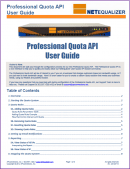
Professional Quota API Guide

If you prefer to use the native commands (NUQ API) instead of the new GUI, OR if you are using a Software Update  prior to 5.8 (< 5.8), please follow the instructions below.  If you are current on NSS, we recommend upgrading to 5.8 to use the new Professional Quota API GUI.  If you are not current on NSS, you can call 303.997.1300 ext.5 or email admin@apconnections.net  to get current.


The following article serves as the programmer’s toolkit for the new NetEqualizer User-Quota API (NUQ API). Other industry terms for this process include bandwidth allotment, and usage-based service.  The NUQ API toolkit is available with NetEqualizer release 4.5 and above and a current software subscription license (NSS).

Note: NetEqualizer is a commercial-grade, Linux-based, in-line bandwidth shaper.  If you are looking something windows-based try these.

Background

Prior to this release, we provided a GUI-based user limit tool, but it was discontinued with release 4.0.  The GUI tool did not have the flexibility for application development, and was inadequate for customizations. The NetEqualizer User-Quota API (NUQ API) programmer’s toolkit is our replacement for the GUI tool. The motivation for developing the toolkit was to allow ISPs, satellite providers, and other Internet management companies to customize their business processes around user limits. The NUQ API is a quick and easy way to string together a program of actions in unique ways to meet your needs.  However, it does require basic programming/Linux skills.

Terms of Use

APconnections, the maker of the NetEqualizer, is an OEM manufacturer of a bandwidth shaping appliance.  The toolkit below provides short examples of how to use the NUQ API to get you started developing a system to enforce quota bandwidth limits for your customers. You are free to copy/paste and use our sample programs in the programmer’s toolkit to your liking.  However, questions and support are not covered in the normal setup of the NetEqualizer product (NSS) and must be negotiated separately.  Please call 303.997.1300 x103 or email sales@apconnections.net to set up a support contract for the NUQ API programmer’s toolkit.

Once you have upgraded to version 4.5 and have purchased a current NSS, please contact APconnections for installation instructions. Once installed, you can find the tools available in the directory/art/quota.

Step 1: Start the Quota Server

In order to use the NUQ API programmer’s toolkit, you must have the main quota server running.  To start the quota server from the Linux command line, you can type:

# /art/quota/quota &

Once the quota main process is running, you can make requests using the command line API.

The following API commands are available:

quota_create

Usage:

quota_create 102.20.20.2/24

Will cause the NetEqualizer to start tracking data for a block (subnet) of IP addresses in the range 10.20.20.0  through 10.20.20.255.

_________________________________________________________________________________________________________

quota_remove

Usage:

/art/quota/quota_remove 102.20.20.2/24

Will remove a block of IP addresses from the quota system.

Note: You must use the exact same IP address and mask to remove a block as was used to create the block.

_________________________________________________________________________________________________________

quota_set_alarm

Usage:

/art/quota/quota_set_alarm 102.20.20.2/17 <down limit>  <up limit>

Will set an alarm when an IP address reaches a defined limit.

Alarm notifications will be reported in the log /tmp/quotalog.  See the sample programs below for usage.

Note: All IPs in the subnet range will get flagged when/if they reach the defined limit. The limits are in bytes transferred. Alarm notifications are reported in the quotalog /tmp/quotalog.  See example below.

_________________________________________________________________________________________________________

quota_remove_alarm

Usage:

/art/quota/quota_remove_alarm 102.20.20.2/17

Will remove all alarms in effect on the specified subnet.

Note: The subnet specification must match exactly the format used when the alarm was created — same exact IP address and same exact mask.

_________________________________________________________________________________________________________

quota_reset_ip

Usage:

/art/quota/quota_reset_ip 102.20.20.2/17

Will reset the usage counters for the specified subnet range

_________________________________________________________________________________________________________

quota_status_ip

Usage:

/art/quota/quota_status_ip 102.20.20.2/24

Will show the current usage byte count for the specified IPs in the range to the console. The usage counters must be initiated with quota_create command.

Will also put usage statistics to the default log /tmp/quotalog

_________________________________________________________________________________________________________

quota_rules

Will display all current rules in effect

Usage:

/art/quota/quota_rules

_________________________________________________________________________________________________________

ADD_CONFIG

Usage:

/art/ADD_CONFIG HARD <ip> <down> <up><subnet mask> <burst factor>

Used to set rate limits on IP’s, which would be the normal response should a user exceed their quota.

Parameter definitions:

HARD                     Constant that specifies the type of operation.  In this case HARD indicates “hard limit”.

<ip>                        The IP address in format x.x.x.x

<down>                 Is the specified max download (inbound) transfer speed for this ip in BYTES per second, this is not kbs.

<up>                       Is the specified upload (outbound) transfer speed in BYTES per second

<subnet mask>   Specifies the subnet mask for the IP address.  For example, 24 would be the same as x.x.x.x/24 notation. However, for this command the mask is specified as a separate parameter.

<burst factor> The last field in the command specifies the burst factor.  Set this field to 1 (no bursting) or to a multiple greater than 1 (bursting).  BURST FACTOR is multiplied times the <down> and <up> HARD LIMITs to arrive at the BURST LIMIT (default speed you wish to burst up to).  For example… 2Mbps <down> HARD LIMIT x 4 BURST FACTOR = 8Mbps <down> BURST LIMIT.

_________________________________________________________________________________________________________

REMOVE_CONFIG

Usage:

/art/REMOVE_CONFIG HARD x.x.x.x

Where x.x.x.x is the base ip used in the ADD_CONFIG HARD command no other parameters are necessary on the removal of the rule.

_________________________________________________________________________________________________________

To view the Log:

Usage:

/tmp/quotalog

Various status messages will get reported along with ALARMs and usage statistics

_________________________________________________________________________________________________________

Examples and Sample sessions (assumes Linux shell and Perl knowledge)

From the command line of a running NetEqualizer  first start the quota server

root@neteq:/art/quota# /art/quota/quota &
[1] 29653
#

Then I issue a command to start tracking byte counts on the local subnet, for this example I have some background network traffic running across the NetEqualizer.

root@neteq:/art/quota# ./quota_create 192.168.1.143/24
Created 192.168.1.143/24
root@neteq:/art/quota#

I have now told the quota server to start tracking bytes on the subnet 192.168.1.*

To see the transferred current byte count on an IP you can use the status_ip command

root@neteq:/art/quota# ./quota_status_ip 192.168.1.143/24
Begin status for 192.168.1.143/24
status for 192.168.1.255
start time = Fri Apr 2 21:23:13 UTC 2010
current date time = Fri Apr 2 21:55:28 UTC 2010
Total bytes down = 65033
Total bytes up = 0
status for 192.168.1.119
start time = Fri Apr 2 21:54:50 UTC 2010
current date time = Fri Apr 2 21:55:28 UTC 2010
Total bytes down = 3234
Total bytes up = 4695
End of status for 192.168.1.143/24
root@neteq:/art/quota#

Yes, the output is a bit cryptic, but everything is there. For example, the start time and current time since the data collection started on each IP reporting in.

Now let’s say we wanted to do something useful when a byte count or quota was exceeded by a user.

First, we would set up an alarm.
root@neteq:/art/quota# ./quota_set_alarm 192.168.1.143/24 10000 10000
alarm block created for 192.168.1.143/24

We have now told the quota server to notify us when any IP in the range 192.168.1.* exceeds 10000 bytes up or 10000 bytes down.

Note: If an alarm is raised, the next alarm will occur at twice the original byte count. In the example above, we will get alarms at 10,000, 20,000, 30,000 and so forth for all IPs in the range. Obviously, in a commercial operation, you would want your quotas set much higher in the gigabyte range.

Now that we have alarms set, how do we know when the happen and how can we take action?

Just for fun, we wrote a little perl script to take action when an alarm occurs. So, first here’s the perl script code and then and example of how to use it.

root@neteq:/art# cat test
#!/usr/bin/perl
while ( 1)
{  $line = readline(*STDIN);
print $line;
chomp ($line);
@foo=split(” “, $line);
if ( $foo[0] eq “ALARM”)
{
print “send an email to somebody important here \n”;
}
}

First, save the perl script off to a file. In our example, we save it to a file /art/test

Next, we will monitor the /tmp/quotalog for new alarms as they occur, and when we find one we will print the message “send and email to somebody important here” .   To actually send an email you would need to set up an email server and call the command line smtp command with your message , we did not go that far here.

Here is how we use the test script to monitor the quotalog  (where ALARM Messages get reported)

root@neteq:/art# tail -f /tmp/quotalog | ./test

Log Reset
ALARM 192.168.1.119 has exceeded up byte count of 160000
send an email to somebody important here
ALARM 192.168.1.119 has exceeded down byte count of 190000
send an email to somebody important here
ALARM 192.168.1.119 has exceeded up byte count of 170000
send an email to somebody important here
ALARM 192.168.1.119 has exceeded down byte count of 200000
send an email to somebody important here
ALARM 192.168.1.119 has exceeded up byte count of 180000
send an email to somebody important here
ALARM 192.168.1.119 has exceeded down byte count of 210000
send an email to somebody important here
ALARM 192.168.1.119 has exceeded up byte count of 190000
send an email to somebody important here
ALARM 192.168.1.119 has exceeded down byte count of 220000
send an email to somebody important here

Now, what if we just want to see what rules are in effect?  Here is a sequence where we create a couple of rules and show how you can status them. Note the subtle difference between the command quota_rules and status_ip.  Status_ip shows ip’s that are part of rule and are actively counting bytes.  Since a rule does not become active (show up in status) until there are actually bytes transferred.

root@neteq:/art/quota# ./quota_create 192.168.13.143/24
Created 192.168.13.143/24
root@neteq:/art/quota# ./quota_rules
Active Quotas —————
192.168.13.143/24
Active Alarms —————-
root@neteq:/art/quota# ./quota_set_alarm 192.168.11.143/24 20000 20000
alarm block created for 192.168.11.143/24
root@neteq:/art/quota# ./quota_rules
Active Quotas —————
192.168.13.143/24
Active Alarms —————-
192.168.11.0/24
root@neteq:/art/quota#

That concludes the NetEqualizer User-Quota API (NUQ API) programmers toolkit for now. We will be adding more examples and features in the near future. Please feel free to e-mail us at support@apconnections.net with feature requests and bug reports on this tool.

Note: You must have a current NSS to receive the toolkit software. It is not enabled with the default system.

Related Opinion Article on the effectiveness of Quotas

Equalizing Compared to Application Shaping (Traditional Layer-7 “Deep Packet Inspection” Products)


Editor’s Note: (Updated with new material March 2012)  Since we first wrote this article, many customers have implemented the NetEqualizer not only to shape their Internet traffic, but also to shape their company WAN.  Additionally, concerns about DPI and loss of privacy have bubbled up. (Updated with new material September 2010)  Since we first published this article, “deep packet inspection”, also known as Application Shaping, has taken some serious industry hits with respect to US-based ISPs.   

==============================================================================================
Author’s Note: We often get asked how NetEqualizer compares to Packeteer (Bluecoat), NetEnforcer (Allot), Network Composer (Cymphonix), Exinda, and a plethora of other well-known companies that do Application Shaping (aka “packet shaping”, “deep packet inspection”, or “Layer-7” shaping).   After several years of these questions, and discussing different aspects with former and current application shaping with IT administrators, we’ve developed a response that should clarify the differences between NetEqualizer’s behavior- based approach and the rest of the pack.
We thought of putting our response into a short, bullet-by-bullet table format, but then decided that since this decision often involves tens of thousands of dollars, 15 minutes of education on the subject with content to support the bullet chart was in order.  If you want to skip the details, see our Summary Table at the end of this article

However, if you’re looking to really understand the differences, and to have the question answered as objectively as possible, please take a few minutes to read on…
==============================================================================================

How NetEqualizer compares to Bluecoat, Allot, Cymphonix, & Exinda

In the following sections, we will cover specifically when and where Application Shaping is used, how it can be used to your advantage, and also when it may not be a good option for what you are trying to accomplish.  We will also discuss how Equalizing, NetEqualizer’s behavior-based shaping, fits into the landscape of application shaping, and how in many cases Equalizing is a much better alternative.

Download the full article (PDF)  Equalizing Compared To Application Shaping White Paper

Read the rest of this entry »

Will the Rural Broadband Initiative Create New Jobs?


By Art Reisman, CTO, www.netequalizer.com

Art Reisman CTO www.netequalizer.com
Art Reisman is a partner and co-founder of APconnections, a company that provides bandwidth control solutions (NetEqualizer) to
ISPs, Universities, Wireless ISPs, Libraries, Mining Camps, and any organization where groups of users must share their Internet resources equitably.

I’m sure that most people living in rural areas are excited about the prospects of lower cost broadband. But, what will be the ultimate result of this plan? Will it be a transforming technology on the scale of previous campaigns implemented for electricity and interstate highways?  Will the money borrowed see a return on investment through higher productivity and increased national wealth?

The answer is most likely “no.” Here’s why…

  1. The premise of a return on investment by bringing bandwidth to rural areas assumes there is some kind of dormant untapped economic engine  that  will spring to life once sprinkled with additional bandwidth. This isn’t necessarily the case.
  2. There is also an implied myth that somehow rural America does not have access to broadband. This is simply not true.

Here are some questions and issues to consider:

Are rural communities really starved for bandwidth?

Most rural small businesses already have  access to decent broadband speeds and are not stuck on dial up.  To be fair, rural broadband currently is not quite fast enough to watch unlimited YouTube, but it is certainly fast enough to allow for VoIP, E-mail, sending documents and basic communication without the plodding of dial up.

We support approximately 500 rural operators around the US and the world.  The enabling technology for getting bandwidth to rural areas is well established using readily available line of sight back haul equipment.

For example, let’s say you want to start a broadband business 80 miles southwest of Wichita Kansas. How do you tap into the major Internet backbone?  Worst case scenario is that the nearest pop to a major backbone Internet provider is in Wichita. For a few thousand dollars, you can run a microwave link from Wichita out to your town and using common backhaul technology. You could then distribute broadband access to your local community using point to multipoint technology. The technology to move broadband into rural areas is not futuristic, it is a viable and profitable industry that has evolved to meet market demands.

How much bandwidth is enough for rural business needs?

We support hundreds of businesses and their bandwidth needs. From our observations, what we have found is that unless a business is specially  a content distribution or hosting company, they purchase minimal pipes, much less per capita than a consumer household.

Why? They don’t want to subsidize their employees’ YouTube and online entertainment habits. Therefore, they typically just don’t need more than a 1.5 meg for an office of 20 or so employees.

As mentioned, bandwidth in rural American towns is not quite up to the same standards as major metro areas, but the service is adequate to ensure that businesses are not at a disadvantage.  Most  high speed connections beyond business needs are used primarily for entertainment -watching videos, playing Xbox, etc. It’s not that these activities are bad, it’s just that they are consumer activities and not related to business productivity. Hence, considering this, I would argue that a government subsidy to bring high speed into rural areas will have little additional  economic impact.

The precedent of building highways to rural areas cannot be compared to broadband.

Highways did open the country to new forms of commerce, but there was a clear geographic hurdle to overcome that no commercial entity would take on. There were farm producers in rural America, vital to our GDP, that had to get product to market efficiently.

The interstate system was necessary to open the country to commerce, and I would agree that moving goods from coast to coast via highway certainly benefits everybody. Grain and corn from the Midwest must be brought to market through a system of feeder roads connecting into the Interstate and rail sytems. And, the only way to transport goods from anyplace must include a segment of highway.

But the Internet transports data, and  there is  no geographic restriction on where data gets created and consumed. So, there is not an underlying need to make use of rural america for economic reasons with respect to data. Even if there was a small business building widgets in rural America, I challenge any government official to cite one instance of a business not being able function for lack of Internet conectivity. I am able to handle my e-mail on a $49 -per-month WildBlue Internet connection 20 miles from the nearest town in the middle of Kansas and my customers cannot tell the difference — and neither can I.

With broadband there is only data to transport, and unlike the geographic necessity of farm products, there is no compelling reason why it needs to be produced in rural areas. Nor is there evidence of an issue moving it from one end of the country to another, the major links between cities are already well established.

Since Europeans are far better connected than the US, we are falling behind.

This comparison is definitely effective in convincing Americans that something drastic needs to be done about the country’s broadband deficiencies, but it needs to be kept in perspective.

While it is true the average teenagar in Europe can download and play oodles more games with much more efficiency than a poor American farmhand in rural Texas, is that really setting the country back?

Second, the population densities in Western Europe make the econimics of high-speed links to everybody much more feasible than stringing lines through rural towns 40 miles apart in America’s heartland.  I don’t think the Russians are trying to send gigabit lines to every village in Siberia, which would be a more realistic analogy than comparing U.S. broadband coverage to Western Europe in general.

Therefore, while the prospect of expanded broadband Internet access to rural America is appealing for many reasons, both the positive outcomes of its implementation as well as the consequences of the current broadband shortcomings must be kept in perspective. The majority of rural America is not completely bandwidth deprived. Although there are shortcomings, they are not to the extent that commerce is suffering, nor to the extent that changes will lead to a significant increase in jobs or productivity. This is not to say that rural bandwidth projects should not be undertaken, but rather that overly ambitious expectations should not be the driving force behind them.

Looks Robert Mitchell in this 2007  PC World article  disagrees with me.

NetEqualizer News: March 2010


March 2010 NetEqualizer News

NetEqualizer News – IPv6 and the NetEqualizer and the Next NetEqualizer Release
 
Greetings!
 
Enjoy another issue of the NetEqualizer Newsletter. This month, we discuss NetEqualizer’s compatibility with IPv6 and our newest NetEqualizer release. As always, feel free to pass this along to others who might be interested in NetEqualizer or AirEqualizer news.

In this issue:

  • IPv6 And The NetEqualizer
  • Cool New NetEqualizer Tool Alert
  • What To Do About YouTube?
  • NetEqualizer Advanced Tips & Tricks 
  IPv6 And The NetEqualizer
   
A couple of weeks ago, a customer called and mentioned that they were being forced to purchase new equipment from a competitor of ours, as their equipment is not firmware upgradeable to IPv6. I am guessing that other vendor is hoping for one of those “y2k windfalls”, where they have a captive audience with no choice but to purchase expensive upgrades.
 
For those of you who currently own or are thinking of purchasing a NetEqualizer product, please do not think you will lose your investment when you go to IPv6. When you are ready for IPv6 in 2010, the NetEqualizer will be too! We are happy to inform you that we have tested our IPv6 patch and expect clear sailing for all customers to upgrade to this when the time comes.
 
All that will be required to apply this patch is that you are current on NSS (yearly software upgrade & support). If you are not sure if you are current on NSS, please email us at admin@apconnections.net with your serial number, and we will check for you.
 
We plan to release our IPv6 patch in Q2 2010. We will also roll it into a Release in Fall 2010. We will update you via this Newsletter when the IPv6 patch is available.
 
For more information on why you might care about IPv6, Wikipedia has a good reference article on the subject at http://en.wikipedia.org/wiki/IPv6.
 
  ***Cool New NetEqualizer Tool Alert***
    New API planned for Release in Fall 2010 to control User Quotas and more!

In our Latest Release (4.2.x), we have removed our User Limit Utility from the NetEqualizer Main Menu Page. Please note: for those of you that depend on it, we will continue to support our User Limit/ Quota Utility that was developed 5 years ago.
 
We have done this because we have thought of a better way to offer this feature to you. Rather than us trying to guess at everything you might need, we are going to let you create Custom IP Quota Actions & Reports that work for you.
 
As a teaser to this upcoming release, we have listed proposed templates (program calls for the upcoming API) below:
 
start_capture(IP) Will begin collection data on an individual IP. Data will include bytes downloaded and bytes uploaded. After calling this routine you will be able to get instant updates of data consumed by that IP.
 
status_ip(IP) Will return a current readout of data downloaded and uploaded on the specified IP, since the issue of the start_capture command.
 
reset_ip(IP) Will reset all counters for upload and download.
 
stop_capture(IP) Will stop data counters on this IP until the next start_capture is issued.
 
time_of_capture(IP) Will return the time of the last start_capture command.
 
With this API it will now be possible for you to write your own utilities to check bandwidth usage by user and also to take action when quotas are reached. It will allow you to easily customize a user-friendly statistics page for your customers to preview, much like checking your phone minutes from a web site or mobile phone.
 
We are also considering ways to enable you to share your custom utilities with other NetEqualizer users. At a minimum, we will do something similar to what we do today with common questions & answers in our NetEqualizer Support Archive on our blog. Look for more details in upcoming issues!
 
Estimated release date for the new API will be Q3 2010. If you have feature requests for this utility, please submit them to us at sales@apconnections.net.
 
  What To Do About YouTube?
   
 
We get a lot of questions about how to handle YouTube, as this has proliferated across the world as the medium to share video. Enclosed is a link to our new blog article, which explores the business cost model behind video. We think it is an interesting read for small-to-mid size ISPs, consumers, and anyone that feels frustrated with sizing a network to accommodate video.
 
 
  NetEqualizer Advanced Tips & Tricks
   
 
This month we are publishing a compilation of NetEqualizer Tips & Tricks that was put together by a long-time NetEqualizer customer (since 2006), Mario Crespo of Adeatel S.A, a wireless Internet provider in the rural zone of Ecuador, South America. Mario graciously offered to put these into one document, using some of the best of that he found in various articles and newsletters from the NetEqualizer website and NetEqualizer blog site.
 
Mario’s hope was to help others quickly and easily find some advanced Tips & Tricks. Thanks Mario for thinking of your fellow NetEqualizer users!
 
 
If you have something to add to this compilation, please email it to us at sales@apconnections.net.
   
Contact Information
email: admin@apconnections.net
phone: 303-997-1300
web: http://www.netequalizer.com 


-
-
APconnections Partners AiBridges
Camada 7
Candela Technologies
DoubleRadius
Extensive Networks
FISPA
Grupo Imaginación Cibernética
Telefonía Pública y Privada S.A.
Tranzeo Wireless Technologies
-
 
-
 
-
-
NetEqualizer News Blog Ever wanted to comment or ask a question about something you’ve seen in the NetEqualizer Newsletter? Now you can at the NetEqualizer News Blog. We’ve set up the blog to help us stay connected with our customers, as well as help our customers stay connected with us. We’ll include updates and news on NetEqualizer and AirEqualizer products, as well as our take on industry news. Here’s where you can find it: http://www.netequalizer.wordpress.com/.

-
 
-

Check Out Our New NetEqualizer Video…

NetEqualizer: Advanced Tuning

Bits to Bytes Conversion Cheat Sheet


For those of you that want a simple way to convert from megabits/sec to bytes/sec, here is an easy way to do it.  Open one of the documents linked below, follow the instructions, and enter your pipe size.  It will do all the conversions for you, so that you have bytes/sec, which is what you enter in the NetEqualizer GUI “trunk_up” and “trunk_down” fields.

MSWord document that contains an embedded spreadsheet.  It is saved as a “.doc” file, so that it can be opened with older versions of MSWord. bitstobytes conversion cheat sheet

OpenOffice.org document that contains an embedded spreadsheet.  It is saved as a “.odt” file.
bitstobytes conversion cheat sheet

NetEqualizer at Whistler Blackcomb Ski Resort


The 2010 Winter Olympics are underway in Vancouver, British Columbia. This week a lot of the alpine skiing events are taking place at Whistler Blackcomb Ski Resort. Whistler is the official Alpine Skiing Venue for the 2010 Olympic and Paralympic Winter Games.

We have had a NetEqualizer in place at Whistler since 2006 (as part of an overall network project implemented by Tranzeo Wireless Technologies, Inc.). Which leads us to wonder, how many of the athletes will use the Whistler network, and hence the NetEqualizer, while in Vancouver?

The 2010 Olympics site lists 314 athletes under “alpine skiing”. So potentially hundreds of competitors are benefitting from our technology! Today I read that Didier Dafago (Switzerland), Aksel Lund Svindal (Norway), and Bode Miller (US) took gold, silver, and bronze respectively in the Men’s Downhill. Maybe now that they are relaxing after their race, they will have time to surf the internet, catch up on email, and chat with friends online – and all hopefully very fast, thanks to Whistler’s NetEqualizer…

Anyways, it is fun to think about all the famous athletes that might be use the NetEqualizer. As you know, our bandwidth shaping products are so good they deserve a medal!

NetEqualizer Bandwidth Shaping Solution: Hotels & Resorts


In working with some of the world’s leading hotels and resorts, we’ve repeatedly heard the same issues and challenges facing network administrators. Here are just a few:

Download Hotels White Paper

  • We need to do more with less bandwidth.
  • We need a solution that’s low cost, low maintenance, and easy to set up.
  • We need to meet the expectations of our tech-savvy customers and prevent Internet congestion during times of peak usage.
  • We need a solution that can meet the demands of a constantly changing clientele. We need to offer tiered internet access for our hotel guests, and provide managed access for conference attendees.

In this article, we’ll talk about how the NetEqualizer has been used to solve these issues for many Hotels and Resorts around the world.

Download article (PDF) Hotels & Resorts White Paper

Read full article …

NetEqualizer Bandwidth Shaping Solution: Business Centers


In working with numerous Business Center network administrators, we have heard the same issues and challenges repeatedly. Here are just a few:

Download Business Centers White Paper

  • We need to do more with less bandwidth.
  • We need a solution that’s low cost, low maintenance, and easy to set up.
  • We need to support selling fixed bandwidth to our customers, by office and/or user.
  • We need to be able to report on subscriber usage.
  • We need to increase user satisfaction and reduce network troubleshooting calls

In this article, we’ll talk about how the NetEqualizer has been used to solve these issues for many Business Centers around the world.

Download article (PDF) Business Centers White Paper

Read full article …

NetEqualizer February Newsletter


February 2010 NetEqualizer News
Greetings!
 
Enjoy another issue of the NetEqualizer Newsletter. This month, we introduce our new animated NetEqualizer video, detailing step-by-step how the technology works. As always, feel free to pass this along to others who might be interested in NetEqualizer or AirEqualizer news.

In this issue:

  • NetEqualizer Technology Explained…In Animation
  • Best Of The Blog
  • Bug Report
  • NetEqualizer: The Animation Process
NetEqualizer Technology Explained…In Animation
NetEqualizer Superhero Video

Over the years, we’ve had several clients ask us for an easy way to explain how the NetEqualizer works. Well, our newest NetEqualizer video may be our best response yet. With the help of People Productions (see below), we’ve captured the NetEqualizer’s approach and effectiveness in two new videos — one straight to the point and the other a little more detailed.
 
So, if you’re looking for an easy way to explain exactly what you’re doing to make your network run smoothly, or are just in need of an overview how the NetEqualizer works, take a look.
 

Quick 45-second Clip

Best Of The Blog
What Is Burstable Bandwidth? Five Points to Consider

Internet providers continually use clever marketing analogies to tout their burstable high-speed Internet connections. One of my favorites is the comparison to an automobile with overdrive that at the touch of button can burn up the road. At first, the analogies seem valid, but there are usually some basic pitfalls and unresolved issues. Below are five points that are designed to make you ponder just what you’re getting with your burstable Internet connection, and may ultimately call some of these analogies, and burstable Internet speeds altogether, into question.
Bug Report
Notice to users of version 4.0 and higher released this December…
We have found a problem with the Subnet Mask feature used with connection limits. If you restart your system, the defined Subnet Masks are ignored on the restart. We have a patch that can be installed without disruption of service. Contact us via e-mail at support@apconnections.net for details.
  
NetEqualizer: The Animation Process
People Productions

The following is a write-up from People Productions, the company behind our new NetEqualizer video, detailing the video’s production process.
 
So, the folks at NetEqualizer gave me a buzz and one month later we have the NetEqualizer super hero. Here is the tale of how she came to life.
We’ve been around for 25 years making tons of videos for trade shows, training videos, promo videos, and a decade ago we started creative web applications and custom iPhone apps, integrating all these different media types and getting them working together. Art Reisman from APconnections called me up and pitched his concept — a metaphorical and visual method to get the simple concept of how NetEqualizer works. NetEqualizer “just works” in simple methods to get it so the bandwidth hogs play fairly with everyone else on the network. After a meeting of the minds, we wrote the script. This is the skeleton that inspires all the visuals. Once we had gotten every last “i” dotted, we recorded the voice over. We have an associate who does great voices, from famous impersonations to the old-time film reel/super hero voice you hear in the video.
Now that the audio bed is complete, we are able to move onto the visuals. We created storyboards that have just a few of the key scenes in the video, close-ups of the cars, our heroine standing proud, and get those over to Art to approve. After a few minor tweaks, we start animating. This 3D stuff requires some heavy-duty gear so we got the graphics guy, Mike, the best computer in the company and many hours of render time.
Once we get the video edited together with the audio, we added in the sound effects of the cars and the music. Add some polishing touches and we are done! 
 
Contact Information
email: admin@apconnections.net

phone: 303-997-1300
  
-
-
APconnections Partners AiBridgesCamada 7Candela TechnologiesDoubleRadiusExtensive NetworksFISPAGrupo Imaginación CibernéticaTelefonía Pública y Privada S.A.Tranzeo Wireless Technologies
-
-

NetEqualizer Bandwidth Shaping Solution: Telecom, Satellite Systems, Cable, and Wired and Wireless ISPs


In working with Internet providers around the world, we’ve repeatedly heard the same issues and challenges facing network administrators. Here are just a few:

Download ISP White Paper

  • We need to support selling fixed bandwidth to our customers.
  • We need to be able to report on subscriber usage.
  • We need the ability to increase subscriber ratio, or not have a subscriber cutback, before having to buy more bandwidth.
  • We need to meet the varying needs of all of our users.
  • We need to manage P2P traffic.
  • We need to give VoIP traffic priority.
  • We need to make exemptions for customers routing all of their traffic through VPN tunnels.
  • We need a solution that’s low cost, low maintenance, and easy to set up.
  • We need a solution that will grow with our network.
  • We need a solution that will meet CALEA requirements.

In this article, we will talk about how the NetEqualizer has been used to solve these issues for Internet providers worldwide.

Download article (PDF) ISP White Paper

Read full article …

NetEqualizer Bandwidth Shaping Solution: Libraries


In working with libraries across the country, we have heard the same issues and challenges repeatedly from network administrators.  Here are just a few:

Download Library White Paper

  • We need to meet the varying needs of all of our patrons while keeping the network truly open to the public.
  • We need to ensure access to our online resources for remote users (online catalogs, databases, etc.).
  • We need to do more with less bandwidth.
  • We need a solution that’s low cost, low maintenance, and easy to set up.
  • We need a solution that will grow with our network.

In this article, we’ll talk about how the NetEqualizer has been used to solve these issues for many libraries around the world.

Download article (PDF) Library White Paper

Read full article …