Deep Packet Inspection DPI a Felony ?


Editors Note: In a recent press release APconnections denounced the use of any and all DPI in its products going forward. A customer brought this Article by Ryan Singel to our attention and it is worth reading if you are wondering where this is going.

Former Prosecutor: ISP Content Filtering Might be a ‘Five Year Felony’

By Ryan Singel EmailMay 22, 2008 | 3:23:35 PMCategories: Network Neutrality, Surveillance

Prison_san_quentin NEW HAVEN, Connecticut — Internet service providers that monitor their networks for copyright infringement or bandwidth hogs may be committing felonies by breaking federal wiretapping laws, a panel said Thursday.

University of Colorado law professor Paul Ohm, a former federal computer crimes prosecutor, argues that ISPs such as Comcast, AT&T and Charter Communications that are or are contemplating ways to throttle bandwidth, police for copyright violations and serve targeted ads by examining their customers’ internet packets are putting themselves in criminal and civil jeopardy.

See the full Article

http://blog.wired.com/27bstroke6/2008/05/isp-content-f-1.html

Other ranting

http://xplornetsucks.blogspot.com/2008/11/internet-packet-spoofing.html

The birth of a new kind of new kind of Packet Shaper (NetEqualizer)


Today my attention was drawn to a forum thread about setting up queuing and bandwidth fairness on a Cisco Router. The techs in the discussion were obviously very familiar with Cisco and its internal programming language. Needless to say it was a very low level discussion and  to make any sense of it would require  sort a Cisco certification on the inner workings of their IOS programming language. The discussion reminded me of a conversation I had back in 2002 when the idea of turn key bandwidth controller popped into my head

In 2002  I was running a start up WISP with a partner. One issue that we saw coming was sharing bandwidth on a tightly contested T1. We decided it was worth looking into what was available, was there something we could just plug in to handle this and get on with our core business of  running the WISP.
My day job at the time was at Bell Labs, and just recently there had been quite  a few defections to Cisco.  So I  decided to tap some of more former coworkers to see if Cisco had anything turn key picked up the phone and asked a couple of peers what a Cisco box could do  support of some form of turn key fairness. ‘Well you can program the IOS bios queues bla bla” I had heard enough. It seemed that although it was definitely possible to do this with Cisco, I just wanted  something to plug  in and forget about it.  I did not have money to hire a Cisco tech and figured many other start up WISPS in my position were in the same boat. Little did I realize at the time, that the NetEqualizer would become an International hit, distributed across all industries (Hospitals, Cable Companies, Universities etc) around the world over the next 6 years.

The model  of how to approach this issue of fairness was already widely used  in the computer server world. Most people are not concerned with  fairness of processes or threads on web server or data base server? Why is that ? Most  modern computer servers  have some form of operating system that insures that the processes running don’t dominate the central processor (usually Linux). The basic idea is that a little timer that keeps track of a processors resources and how much a process has used if they HOG too much this timer kicks and allows others to get their turn.

The point of this story is there is no manual intervention needed, computers are so cheap that it would be absurd to pay somebody to do this, but that was not always the case. As late as 1986 the Main Frame computer dominated data processing, and with a main frame came a computer operator , a human who had the task of making sure jobs (as there were called) ran to completion in a timely manner,  as well as making sure tape drives were loaded etc.

Do you see the parallel here ? As computers became cheaper it was not economical to employ somebody to watch over this resource, the job still existed  but it was automated and incorporated into the operating system.

Flash forward to 2002, what my Cisco  freinds were  proposing was a labor intensive solution to managing a resource (bandwidth). So the idea was to take this one aspect of managing a network and essentially fire the operator (or the Cisco programmer) And so it was born an automated fairness device for sharing bandwidth and we have no looked back since.

Resources on computers and ways to handle this type of thing were invented back in the 70’s and became wide spread with the death of the card reader.

Editors note: CIsco is a fine product and perhaps there is some easy way to perform this function and I am just too stupid to understand.
Delusions of Net Neutrality


I saw this post this morning, and I thought it was fantastically well written and informative.

Delusions of Net Neutrality

A mathematics professor at the University of Minnesota, Andrew Odlyzko, has a pretty blistering critique of Internet Service Provider’s (ISPs) arguments against net neutrality and about their love of streaming over download. It’s worth a read of the abstract if nothing more – his paper, The delusions of net neutrality (caution, links to a pdf) destroys many a myth of the internet and video. Having been to many a conference lately where the best minds in the room can only imagine the internet making a better tv, I appreciate some astute analysis of the reality.

Odlyzko shows that ISPs and others are pushing for a world where the goals of the internet are reduced to streaming movies, in relatively walled envrionments, and that the costs to build a network capable of this demand that net neutrality be curtailed.

Full Article

Death to Deep Packet (layer 7 shaping) Inspection


Editors note: Deep packet inspection (layer 7 shaping) will likely be around for a while. It is very easy to explain this technology to customers, hence many IT resellers latch on to it as it makes a compelling elevator pitch.  We put out the press release below to formalize our position on this issue.

For detailed information on how the techniques of NetEqualizer differ from Deep Packet inspection, see the following link: http://www.netequalizer.com/Compare_NetEqualizer.php

LAFAYETTE, Colo., October 28, 2008 — APconnections, a leading supplier of plug-and-play bandwidth shaping products, today made a formal announcement to formally discontinue  deep packet inspection techniques in their NetEqualizer product line.

“Our behavior-based techniques worked so well that current customers stopped asking for the layer-7 techniques we had at one time implemented into our system,” said Art Reisman, CEO of APconnections. “So, we eventually just decided to phase the technique out completely.”

Although deep packet inspection, also known as layer-7 shaping, was unofficially discontinued nearly two years ago, the ongoing debates over user privacy spurred the official announcement.

“What prompted us to make a formal announcement was the continued industry lack of understanding that deep packet inspection not only does not work very well, but it also puts you are at risk of violating privacy laws if you use these techniques without customer consent,” said Reisman.

Although Reisman says most providers cross this line with the good intentions of controlling traffic congestion, the reality of it is that it’s no different than listening to a private phone conversation and terminating the call if you don’t like what you hear.

“It’s quite risky  that any public US based ISP would invest in  this technique, especially after the FCC slapped Comcast’s wrists in a recent decision” said Riesman.

For more information on the NetEqualizer technology, visit www.netequalizer.com or contact APconnections at 1-800-918-2763 or via email sales@netequalizer.com.

The NetEqualizer is a plug-and-play bandwidth control and WAN/Internet optimization appliance that is flexible and scalable. When the network is congested, NetEqualizer’s unique “behavior shaping” technology gives priority to latency sensitive applications, such as VoIP and email. It does it all dynamically and automatically, improving on other bandwidth shaping technology available.

APconnections is a privately held company founded in 2003 and is based in Lafayette, Colorado.

NetEqualizer a Great ROI Purchase for Reducing T1, E1, DS3 Costs


If you are looking to cut costs with the recent downturn in the economy, now would be a good time re-visit the issue of bandwidth optimization. How can it be cost justified ?

First, ask yourself if you’re maxing out your Internet connection. If the answer is yes, then you should look at optimizing tools before purchasing more bandwidth.  However, some are quite expensive and hard to swallow, making it difficult to justify the expense. But, NetEqualizer offers a very competitive fixed price solution with no recurring costs.

There are two basic cost-savings factors with the NetEqualizer:

1) Greatly reduced IT labor — For most business, the largest single line item cost is human labor.  And one of the hardest labor costs to quantify is your IT.  Your IT staff may seem to somehow make themselves essential to every issue, no matter how hard you try to automate things.

On the issue of complaints that “the Network is slow,” if you were to sit back and conservatively look at tech time spent fiddling with routers or your expensive layer-7 based packet shaper, you’d probably notice that quite a bit of time is spent making adjustments and tweaking equipment on a weekly or daily business, only to repeat the fire drill the next time the network grinds to a halt.

Why is this?

Nine times out of ten,  the core problem is too much congestion, and to compound matters,  the  acute  source of the congestion changes. It is the transient nature of the cause that tends to drive up your labor costs. Yes you can find and head off problems with your router or deep packet inspection device, but you have to re-visit this issue each time the congestion source changes. Great for keeping techs busy, but bad for costs.

The big advantage with the NetEqualizer over the layer-7 shapers, or using a reporting tool and manually chasing issues on your router, is that the NetEqualizer proactively finds and eliminates network congestion before it blows up in your face, becoming an IT fire drill. Over and over again we hear from customers that they have deployed the NetEqualizer with our default setup,  plugged it in, and left it alone.

So, if you’re looking to save money in this downturn, have your IT support do something that helps generate revenue, like forward-facing customer support, and let the NetEqualizer put out the fires before they spread.

2) Stretching your existing  bandwidth to accommodate more users — Essentially, this allows you to indefinitely stave off signing a new bandwidth contract.

NetEqualizer can stretch the life of your current Internet trunk. Internet congestion is similar to the problem power companies face. They must have enough capacity on their grid to meet peak demands even though they may rarely need it. The same holds true for your Ineternet contract. You must purchase a contract with ample bandwidth to meet your peak loads.  But, as you may realize, much of your peaks are transient and they are also related to quite a bit of non-business traffic. The NetEqualizer is effective because it can spread your non-essential traffic out over time, smoothing out your peaks.

For more information on the NetEqualizer, including a live demo and price list, visit www.netequalizer.com.

Proactive ISP Mikrotec, a Kentucky-based Internet Service Provider


An article by Jagan Jagannathan on TMCnet caught my attention today. For all of our NetEqualizer ISP customers competing with Tier 1 providers, you are likely aware that it is your superior customer service that retains your base.

Mikrotec has a very proactive service to pre-call customers when they spot a problem, a big hit with their subscribers.

Here is an excerpt from the article…

One of the service providers offering proactive support services is Mikrotec, a Kentucky-based Internet service provider that has branded this service Pro-Alert. Pro-Alert offers the broadband provider “live, dynamic visibility” into the performance and availability of every subscriber and application across the entire network ecosystem. This enables Mikrotec to proactively take action on an issue before one of their customers has even noticed that there might be a problem.

Here is a link to the full article: http://callcenterinfo.tmcnet.com/analysis/articles/43534-customer-king-proactive-customer-support.htm

The Pros and Cons of Technology Showdowns (for traffic shapers and more)


This is my second re-write of this quick post discussing the pros and cons of a tech showdown (i.e., pitting two products head-to-head in a trial demo duel). In my first edition, I put together a big list with very politically correct pros and cons.  And then I tossed it. Instead, I am just going to really speak my mind and shorten it a bit.  So here goes. Pulling no punches this time…

1) Assuming you have two or more very high-end solutions to choose from, are truly undecided, and are planning to purchase one of them, then by all means get those vendors in there an make them show them your stuff. But if for some reason you can eliminate one of them early, try to do so.  A showdown should be a final tie breaker, not the first thing you try.

2) Try to avoid a showdown (for political reasons) if  you are pretty sure you know what you want already. Do some background checks on the product.  With the information available on the Internet today, a bad product can’t hide.  Then,  if everything checks out, settle with your first choice and purchase it.  Obviously, make sure you can return it if for some reason it does not live up to expectations.

3) If you are doing a showdown because you have  tech time and no capital budget right now, then please have your techs do something else with their time.

Showdowns drive up product costs for everybody: the vendor, yourself, and future buyers in the industry.  Yes they are a valid tool and necessary in many situations, but please use some discretion.  The time, money, and resources saved by foregoing an uneeded showdown will help the tide come in and raise all ships.

NetEqualizer Direct Sales and Restocking Fee


A customer recently stated that the restocking fee we charge gave the appearance of a lack of confidence in our product. I can appreciate that perception, especially with all the failed products many IT professionals have been burned with over the years.

However, here is the official reasoning behind why we charge a restocking fee.  As taken from my response to this customer:

The restocking fee has its roots based on a couple of factors

1) The restocking fee is designed to make sure we don’t get inundated with requests for free units from customers that are “just looking”. The other vendors  you mention charge much higher prices, sometimes four times as much,  and they typically use a channel that already purchases stock for the purposes of demo’s. All of this cost gets passed along to the customers that end up buying the product (basically covering the cost of dry wells).  We sell mostly direct and with  no local presence it is difficult to know a customer’s buying patterns.   You’d be surprised how many customers will trial something  without any intention to purchase.  But, many times it is not the immediate customers fault as the CIO might change the IT manager’s  budget, etc.

2) We are  not 100-percent certain that our unit will solve your issue. I’d  say we are closer to 80-percent certain based on what you described, but we will easily provide you with $200 of support helping you figure out what your issue is. You will have the chance to talk directly to our engineers who trouble shoot thousands of networks a year with similar problems. We do not want or pretend to be a consulting company, but we don’t want to consult without recouping some of our cost either — especially with our low margins which we are already passing along.

APconnections Is Coming to Massachusetts


On October 14, we will be hosting a complimentary seminar at Gordon College in Beverly, Massachusetts.

We’ll cover:

  • The various tradeoffs regarding how to stem p2p and bandwidth abuse
  • Recommendations for curbing RIAA requests
  • Demo of the new NetEqualizer network access control module (see article above)
  • Lots of customer Q&A and information sharing on how Gordon is using the NetEqualizer, including some hands on probing of a live system

When: October 14, 10 a.m.

Where: Conference Center
Gordon College West Campus
50 Dunham Road
Beverly, MA 01915

This will be a great opportunity to learn more about the issues and challenges facing network administrators as well as to see the full capabilities of the NetEqualizer firsthand. If you’re in the area, be sure not to miss it! For more information, contact us at admin@apconnections.net. To RSVP, send an e-mail to russ@gordon.edu.

Network Access Control Features Redirection for Delinquent Customers


What should an Internet service provider do to customers who are late with their payment?   If you simply block the user completely  at your firewall, you will likely generate a costly call to  your support engineering. But, there are other options…

A better way to collect payment without creating support calls is to redirect the delinquent user to a splash screen  informing them they need to pay their bill.  Obviously a customer won’t call unless they are ready to pay, hence no costly call to support engineering. For the suggested redirection capability, you do not need a fully automated network access control system (requiring a login  and credit card payment), but you do need a way to redirect delinquent customers to a Web page telling them to pay their outstanding bill.

With our latest version that is available now, we can set up IP redirection to a custom web page for a nominal support charge.

Note:  We now host the redirection page right on your NetEqualizer, so there is no need for another third party server.

Call us if you are interested:  303-997-1300
www.netequalizer.com

Building a Technology Company from Scratch


Editors note: We wrote this article about a year ago before the blog was established. Although this article chronicles the model used to bootstrap the NetEqualizer from open source, the basic formula applies to any aspiring open source developer.

When we started the APconnections (APconnections makes the popular bandwidth shaping tool NetEqualizer), we had lots of time, very little cash, some software development skills, and a technology idea. This article covers a couple of bootstrapping pearls that we learned to implement by doing.

Don’t be Afraid to Use Open Source

Using open source technology to develop and commercialize new application software can be an invaluable bootstrapping tool for startup entrepreneurs. It has allowed us to validate new technology with a willing set of early adopters who, in turn, provided us with references and debugging.

We used this huge number of early adopters, who love to try open source applications, to legitimize our application. Further, this large set of commercial “installs” helped us ring out many of the bugs by users who have no grounds to demand perfection.

In addition, we jump-started our products without incurring large development expense. We used open source by starting with technology already in place and extending it, rather than building (or licensing) every piece from scratch.

Using open source code makes at least a portion of our technology publicly available. We use bundling, documentation, and proprietary extensions to make it difficult for larger players to steal our thunder. These will account for over half of development work but can be protected by copyright.

Afraid of copycats? In many cases, nothing could be better than to have a large player copy you. Big players value time to market. If one player clones your work, another may acquire your company to catch up in the market.

The transition from open source users to paying customers is a big jump, requiring traditional sales and marketing. Don’t expect your loyal base of open source beta users to start paying for your product. We use testimonials from this critical mass of users to market to paying customers who are reluctant to be early adopters (see below).

Channels? Use Direct Selling and the Web

Our innovation is a bit of a stretch from existing products and, like most innovations, requires some education of the user. Much of the early advice we received related to picking a sales channel. Just signup reps, resellers, and distributors and revenues will grow.

We found the exact opposite to be true. Priming channels is expensive. And, after we pointed the sales channel at customers, closing the sale and supporting the customer fell back on us anyway. Direct selling is not the path torapid growth. But as a bootstrapping tool direct selling has rewarded us with loyal customers, better margins, andmany fewer returns.

We use the Internet to generate hot leads, but we don’t worry about our Google ranking. The key for us is to get every satisfied customer to post something about our product. It probably hasn’t improved our Google ratings but customer comments have surely improved our credibility.

Honest postings to blogs and user groups have significant influence on potential customers. We explain to each customer how important their posting is to our company. We often provide them with a link to a user group or appropriate blog. And, as you know, these blogs stay around forever. Then, when we encounter new potential customers, we suggest that they Google our “brand name” and blog, which always generates a slew of believable testimonials. (Check out our Web site to see some of the ways we use testimonials.)

Using open source code and direct sales are surely out-of-step with popular ideas for growing technology companies, especially those funded by equity investors. But they worked very well for us as we grew our company with limited resources to positive cash flow and beyond.

NetEqualizer Evaluation Policy


Our official policy for customers requesting evaluation units is to require payment upfront.  However, we do honor a no-questions-asked  30-day return policy.

As you can imagine, we get a constant stream of requests for evaluation units. Obviously we’d love to provide everybody who asks with a demo unit. After all, the other brand name packet shapers will throw them at you. Especially if you are coming from an account they want to win over.

So, you may be wondering why we don’t do the same…

Some background:

APconnections  sells quite a few units under $3000 dollars. To put this in perspective, last year a CEO from a larger competitor selling similar equipment admitted that $4000 is their break-even point.

So, how do we offer units starting at $2000 and still turn a profit?

A big part of our model to is make sure that we do not drill dry wells. Dry well is industry speak for pursuing business that will never materialize. Yes, we love chatting with people, but in order to pay our engineers and stay in business, we must limit money spent supporting customers that are just “looking”.  The easiest way to do this is to enforce our evaluation policy.

Serious customers that are ready to buy something but need to see it work in their network usually have no problem with purchasing up front.  Some, but not all, customers that are not agreeable to purchasing up front may have cash flow problems of their own. In an economy where banks do not know how to qualify loans, we don’t want  to try to calculate this risk.

The result of our conservative policy translates to much lower prices , and to date nobody is arguing with that.

NetEqualizer the Safe Bet for Optimizing Internet Link During Economic Downturn


We just announced a record profit for the quarter ending September 2008. I have included a copy of that announcement below.

Although we do not believe (or want to see) our success come at the expense of other players in the market, there is a strong contrast if you compare our performance to the higher-cost publicly-traded players in this market (see charts below).

I suspect these high-end shapers with expensive sales channels  may have trouble in this slowing market as they come under price pressure. IT departments continue to cut costs and the main play  of optimization products, reducing  ROI,  will lose some luster as Internet costs slowly fall. At some point, a high-end piece of equipment will lose out to adding more bandwidth.

NetEqualizer, on the other hand, is priced so much lower than these other products that our window of value will extend out at least another 10 years — perhaps more.

Although we are private company, we would be happy to share financials under NDA with any customer that has concerns going forward.  We have plenty of operating cash on hand and will likely expand as we pull out of this downturn and customers continue to look to reduce costs.

Stock charts for major players in the Internet/WAN optimization market

http://finance.yahoo.com/q/bc?s=RVBD&t=1y

http://finance.yahoo.com/q/bc?s=ALLT&t=2y&l=on&z=m&q=l&c=

http://finance.yahoo.com/q/bc?s=BCSI&t=1y&l=on&z=m&q=l&c=

Now, here’s our latest press release reporting profits…

———————————————————-

APconnections Announces 50-percent Increase in Profits During Current Quarter

LAFAYETTE, Colo., Sept. 22, 2008 — APconnections, a leading supplier of plug-and-play bandwidth shaping products, today announced that sales revenues have increased by 50 percent during the current quarter.

Company officials report that APconnections is finding that a growing number of ISPs, businesses, libraries, and universities are looking to the NetEqualizer to solve their Internet bandwidth congestion issues, oftentimes switching from more expensive traffic shaping solutions.

As companies deal with the ongoing economic struggles that have hit the nation, the NetEqualizer’s rare combination of effectiveness and affordability has been a major factor fueling this growth.

Other factors driving the upturn are:

  1. Comcast has adopted a similar fairness-based strategy to solve Internet congestion issues, thus validating APconnections’ long-held belief that deep packet inspection is on its way out. (See APconnections’ previous announcements on net neutrality: http://www.netequalizer.com)
  2. Direct sales and support for 90 percent of their customers, thus reducing the overall cost of sales.
  3. Simple turnkey set-up allowing new customer installations to require only one hour of support.

The NetEqualizer is a plug-and-play bandwidth control and WAN/Internet optimization appliance that is flexible and scalable. When the network is congested, NetEqualizer’s unique “behavior shaping” technology gives priority to latency sensitive applications, such as VoIP and email. It does it all dynamically and automatically, improving on other bandwidth shaping technology out there. It controls network flow for the best WAN optimization.

APconnections is a privately held company founded in 2003 and is based in Lafayette, Colorado.

Update: NetEqualizer Access Control Module Running Live at Portola Hotel & Spa


Well, we did it. The new NetEqualizer access control module is now up and running at the Portola Hotel and Spa in Monterey, California. Of course, we wanted to be there for the maiden voyage.

We retrofitted one of the existing NetEqualzier bandwidth controllers at the Portola Hotel with our network access controller and have been live in their lobby areas without an issue going on 36 hours now.

According to Phillip Pennington of Portola Plaza’s IT department, he was not surprised with the results as our NetEqualizer products (they have four of them) have worked flawlessly throughout the complex since being installed 18 months ago.

We have just a few minor customizations to make for their billing needs, and plan to bring up the rest of the hotel in January 2009.

If you were waiting for our latest release with our NAC, now is a good time to call.

The price for any trials next month will start at $2500 and include two hours of consulting.

Note: Customers will need some HTML experience to customize their text pages. Customers will also need to meet basic network configurations to be eligible. Contact us for details at 303-997-1300 or see our Web page for more information.

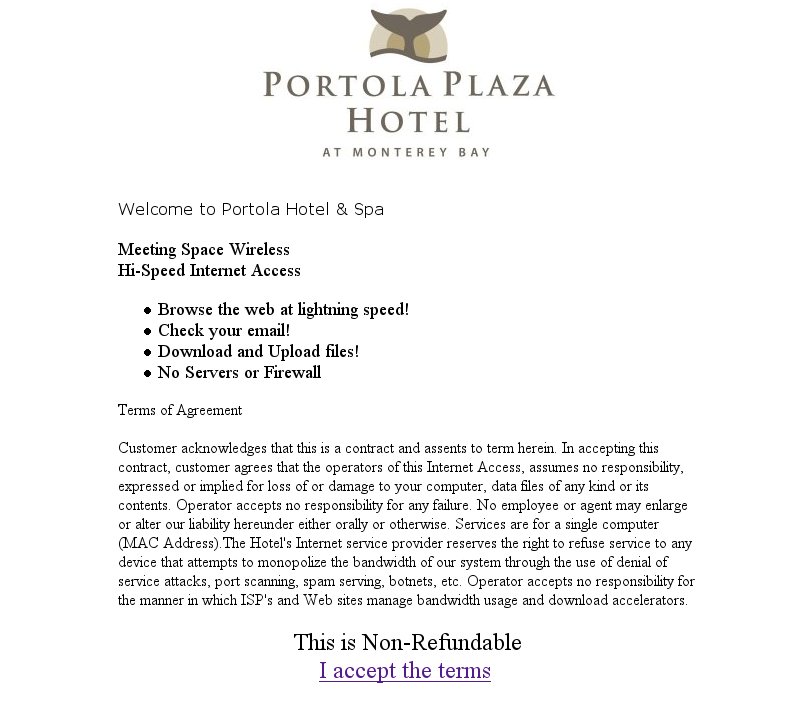
Portola Plaza Personalized Welcome Screen

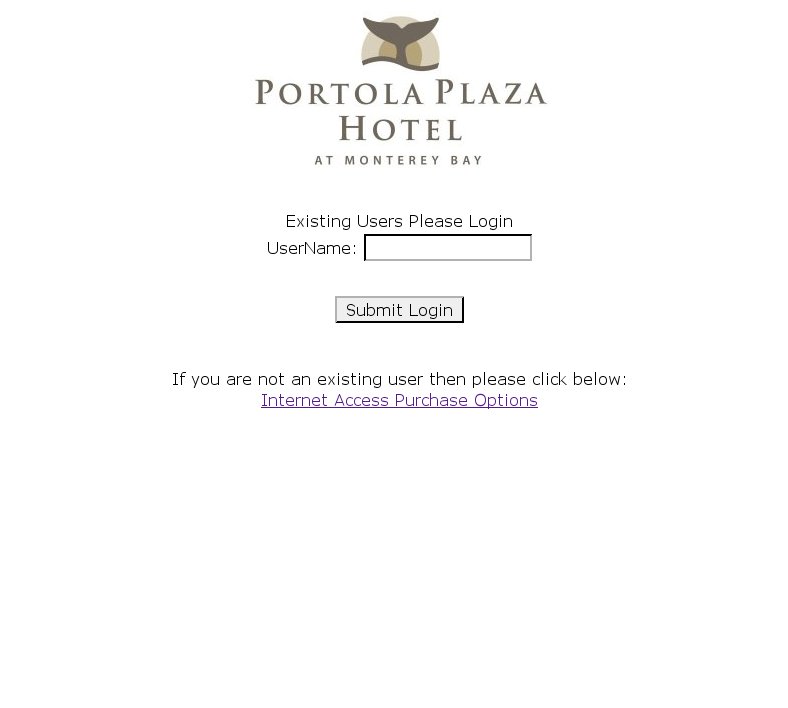
Returning Users Sign In Screen

NetEqualizer Network Access Control Rollout


After several months in development, the NetEqualizer network access control module is now available for trial.

The basic features of the Module are what you would expect (think airport T Mobile daily access etc):

1) The ability to dynamically authenticate/restrict users through a login process.

2) Automated payment processing for users who do not have a login.

3) The ability to selectively exempt an IP range from authentication redirection server. For example well known IP addresses on your network will not be forced to login, while other open IP address ranges (guest network) will require a login to obtain access.

4) The ability to custom brand  login pages and redirection service

Plus a couple of new twists that go above and beyond normal Network Authentication products:

1) Class of Service Specification When Customers Sign Up

For example, you will be able to offer customers a free standard service at modem speed with an option to pay for an upgrade for a faster connection. We have been playing with this feature at the office with our test system and the option to upgrade is very compelling. This could be a great way to increase revenue for those who might otherwise not log on at all if asked to purchase up front. Of course, this is made possible because the network access control is hosted by our NetEqualizer platform with full access to rate limiting features.

2) Group Licenses

This was one of the main requests from Portola Plaza Hotel (our beta site). They wanted to know if we could offer a system that allowed them to sell a group license (limited by total simultaneous sessions) to conference attendees. The other part of the challenge was to maintain a pay as you go option for individual hotel guests at the same time. Well, we have all that in there and it really is pretty impressive!

3) Smooth Service

For those hotels and institutions that have not been able to pull the trigger on something to eliminate their busy hour congestion, they will get the full power of our automated bandwidth controller. Many hotels and institutions have too many irons in the fire to address this issue, and perhaps their management cannot quantify the cost of slow Internet service, so they just live with it. These same institutions love to implement pay for internet service because that feature is clear-cut revenue generating device. So, now they will get both — revenue and smoother service for their paying customers all in one swoop!

4) Reliable Engineering

As many of our customers already know, we are an engineering company that developed a product, not an investor with a business plan that hired an engineering company. What this means is that our roots are conservative and we are in no hurry to put a solution on the market that will cause customers headaches as a result of some greedy business plan and offshore engineering. We do the work here in the U.S. and pay our engineers salaries of U.S. quality. The end result is a smoother process from start to finish. In addition, we are very conservative with our roll out and will not sell more than we can support at one time.

Needless to say, we were very excited to see the control module in action. It’s been even better to see that the months of research and development have paid off. For more information about the NetEqualizer network access control module, please visit our Web site at www.netequalizer.com.