NetEqualizer News: September 2013


September 2013

Greetings!

Enjoy another issue of NetEqualizer News! This month, we request your help in finding a location for our next NetEqualizer Tech Seminar, update you on our Fall Release progress, go over our 10 Year Anniversary charitable giving results, preview our new website design, talk about our leasing program, and invite you to a presentation held at a local Linux users group. As always, feel free to pass this along to others who might be interested in NetEqualizer News.

A message from Art…
Art Reisman, CTO – APconnections

IMG_0884This year, fall is coming slowly to Boulder, Colorado. In late August, we were experiencing several weeks of 90 degree+ (F) weather – which is great for my backyard garden tomatoes and peppers, so at least that’s a benefit. But I am ready for some cooler fall temperatures. On that note, our 2013 Fall Release is almost ready, and we plan for a late October harvest complete with lots of new features!

We love it when we hear back from you – so if you have a story you would like to share with us of how we have helped you, let us know. Email me directly at art@apconnections.net. I would love to hear from you!

Wanted: Tech Seminar Location

We are looking for a host for our next seminar! Possible locations are not limited to the United States and anyone across the world willing to have this half day event should not hesitate to contact us!neteq seminar logo with border

The seminar brings our CTO, Art Reisman, directly to you. In this presentation, Art explores the NetEqualizer technology in detail, and answers your technical questions. So, whether you are an existing customer or just starting to think about bandwidth shaping, come learn more about the NetEqualizer technology and share your experiences with other customers. Remember – this is not a marketing presentation; it was created by techies, for techies!


Update on 2013 Fall Release

Our Fall Release is almost ready and we’ve selected the final features that will be implemented in the release. They are:

* Show All Rules for an IP – easily see which rules apply to a given IP for quick troubleshooting and reporting.

* Network Load Graph – a simplified version of the ntop load graph so you can see bandwidth usage over time.

* NSLookup Capability – do an NSLookup of any IP address in your active connections. If your organization uses dynamic DNS, this is the feature for you.

Each feature helps enhance our Dynamic Real-Time Reporting tool (RTR) and we are excited to continue improving this interface. We’d love to hear your ideas on what else could be included (either new features for the GUI or ntop features you’d like to see incorporated into our reporting tool). Screen Shot 2013-09-09 at 2.44.26 PM

Our last feature listed (NSLookup Capability) was a request by NetEqualizer customer James Watson – Director of Technology Services at Spring Independent School District. Thanks James!

This summer we asked for your input on new features and we received a lot of great ideas. We’d like to thank all of the people who sent us suggestions. We’ll certainly keep those around and try to incorporate them into future releases!

Our Fall Release will be free to customers with valid NetEqualizer Software and Support who are running 7.0+. If you are not current with NSS, contact us today!

sales@apconnections.net


10 Year Anniversary Charitable Giving Summary!APconnections 10 Year Celebration

Throughout the summer we were celebrating our 10 year anniversary by donating a portion of all NetEqualizer sales to a

charity of the customer’s choice. We ended up giving away substantial donations to the following charities:

1) Habitat for Humanity

2) Doctors Without Borders

3) The Hunger Project

4) UNICEF

habitat_for_humanity_logo doctors without borders
The Hunger Project unicef_logo

Thanks to all of our new and existing customers who helped make this a great summer of giving!


Coming Soon: New Website Design!

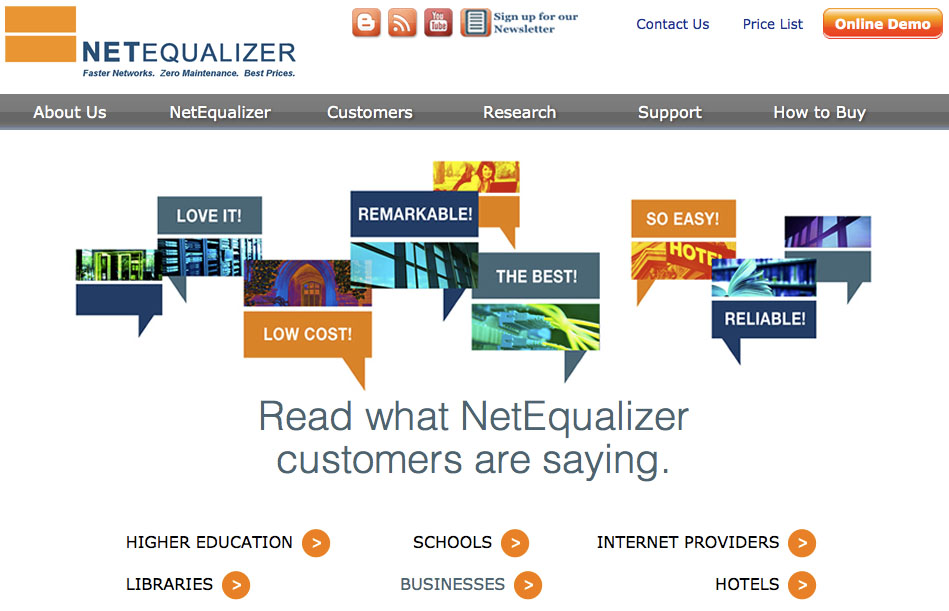
We have been working with a graphic designer the last couple months to make our website easier to read and use. We’ve already updated our Customers page – here is a screenshot:

cust

Next up – a new main page which will include our new look and feel. We will roll out the changes this fall with an updated site to be live by January 2014.

Look for that in an upcoming newsletter!


Leasing Program a BIG Hit

In July we announced our new NetEqualizer Leasing Program, and since it went live we have seen a great adoption rate. We are getting feedback that the program is working well for folks that need to align monthly expenditures with a monthly revenue steam – models commonly used by Business Centers and Internet Service Providers (for example).

If you are a business owner in either of these verticals, you should check out our Leasing Program to see if it meets your needs.

lease


Local Linux Club Talk

If was not for the Linux community, and all the early adopters who trialed our very early NetEqualizer (raw versions) – numbering 10’s of thousands – there would likely be no NetEqualizer alternative in the traffic shaping space.

The cost structure to market a boot-strapped company would otherwise require VC money and our price points would be 3 to 4 times as much to recoup their investments.

The Clue Denver group is one of the most active Linux user groups in the country and we have recently been scheduled to speak at one of their upcoming meetings! We can’t wait to go back and speak to them and get some of their ideas on future products!

Check out their meeting calendar and if you are in the Denver, CO area, stop on by!


Best Of The Blog

Who is Your Customer?

By Art Reisman – CTO – APconnections

My morning ritual involves stopping in at my Local Grocery Store for  a cup of coffee at their branded coffee stand. Sometimes I also pick up a few grocery items before heading into the office. At this particular King Soopers, before 7:00 am, they don’t have any checkout lanes open. My only option is the automated line. The automated lanes are great when you have  one or two standard coded items, but every once in a while I forget the rules, and make the mistake. Never buy an un-coded bakery item, or some produce that the scanner does not know how to handle, doing so can make you the laughing stock of the store. The employees will huddle in the back room giggling at you on the security camera as you paw through endless menu options for a muffin that does not exist in the system.

This morning my first clue that something was amiss was that there were two check lanes open with attendants and baggers. All this at 6:45 in the morning. I also noticed somebody under the fresh flowers scrubbing the crud off the wood floor where the moisture seeps, two people organizing carts, and some strange men in suits huddling around the demo food vendors. Wait a second, demo food vendors at 6:45 in the morning?

“So is the CEO coming into the store today”, I asked the attendant who was dressed in some newly printed shirt, scrawled with a Dilbert slogan about customer service.” No not the CEO – he was here last week – today, we have the Vice President of sales visiting,” she replied…

Photo Of The Month

plane
Jackson Hole Airport
Sometimes we travel to support our various customers around the world if the situation requires some hands-on work. We recently found ourselves in beautiful Jackson, Wyoming – a wintry, high-altitude paradise north of our home in Colorado.

How Much Will That Replacement 3D Printer Cartridge Cost


By Art Reisman

CTO http://www.netequalizer.com

In case you haven’t heard, Jeff Bezos, of Amazon Fame is tossing around idea of using 3D printers to provide unlimited inventory in all of their local warehouses. I suspect this is more of a proclamation for publicity rather than a near term reality?   A 3D printer is just  a catchy name for a new way to do injection molding.  It involves a process  that lays down material in slices, one on top of each other under the guidance of a computer, until the  slices stack up into the finished part. I don’t doubt this  process will obsolete  100+ year old injection molding techniques, but beyond economizing the parts business, I just don’t see a mesh of generic warehouses able to deliver products on demand through 3D printing. For example, if I dropped all the parts needed to build a Harley Davidson at the local hardware store for final assembly, would you want to buy the finished product ?   Modern manufacturing takes advantage of extreme agile and automated assembly line techniques to build anything.  Sourcing parts on demand with a local, one-off assembly would greatly inflate consumer costs for anything more complex than a paperweight.

As for my question about the replacement cost for the printer cartridge, I am more worried about the next-generation paper jam,  hot liquid plastic spewing out all over my desk.

Who is Your Customer?


By Art Reisman

CTO – netequalizer.com

My morning ritual involves stopping in at my Local Grocery Store for  a cup of coffee at their branded coffee stand. Sometimes I also pick up a few grocery items before heading into the office. At this particular King Soopers, before 7:00 am, they don’t have any checkout lanes open. My only option is the automated line. The automated lanes are great when you have  one or two standard coded items, but every once in a while I forget the rules, and make the mistake. Never buy an un-coded bakery item, or some produce that the scanner does not know how to handle, doing so can make you the laughing stock of the store. The employees will huddle in the back room giggling at you on the security camera as you paw through endless menu options for a muffin that does not exist in the system.

This morning my first clue that something was amiss was that there were two check lanes open with attendants and baggers. All this at 6:45 in the morning. I also noticed somebody under the fresh flowers scrubbing the crud off the wood floor where the moisture seeps, two people organizing carts, and some strange men in suits huddling around the demo food vendors. Wait a second, demo food vendors at 6:45 in the morning?

“So is the CEO coming into the store today”, I asked the attendant who was dressed in some newly printed shirt, scrawled with a Dilbert slogan about customer service.” No not the CEO – he was here last week – today, we have the Vice President of sales visiting,” she replied.

I guess the VP of sales must bring them a ton of business because they were rolling out the red carpet like he was a Vegas high roller.

This reminded me of my early days as an engineer in Eagan Minnesota, at Sperry Corporation, when I had to break down all my experimental circuit boards in my Lab, and sit there, politely acting intelligent for two full days, because the VP of engineering was coming for a visit and might tour our lab at some point.

Sperry went under shortly after that incident. King Sooper’s parent company is healthy right now, and perhaps my experience is isolated and unfair.

I still ask the question, who is your customer?

NetEqualizer News: August 2013


August 2013

Greetings!

Enjoy another issue of NetEqualizer News! This month, we discuss the power of RTR, preview Software Update 7.3 and features for our Fall 2013 Release, remind you about our 10 Year Anniversary Celebration which finishes this month, and highlight our recent charity golf tournament sponsorship. As always, feel free to pass this along to others who might be interested in NetEqualizer News.

A message from Art…
Art Reisman, CTO – APconnections

art_smallEvery now and then I get a chance to get out in the field to talk to customers.  Recently I had a chance to work on an installation in Finland for their high-speed train system. It was great to get out of the office and also to immerse myself in another culture. I get to see firsthand what customers are looking for from us, and how they use our products to solve their problems.

Let me know if you use our products in a creative or unique way, or if you have a network issue you would like solved! I like to hear about your most challenging problems.

We love it when we hear back from you – so if you have a story you would like to share with us of how we have helped you, let us know. Email me directly at art@apconnections.net. I would love to hear from you!

The Power of the Real-Time Reporting Tool

Over the last month we’ve been refining our Real-Time Reporting (RTR) tool that is included in all installations running Software Update 7.0+. The RTR tool analyzes and reports on current traffic in real time surrounding two major features:

* Pools
* Active Connections

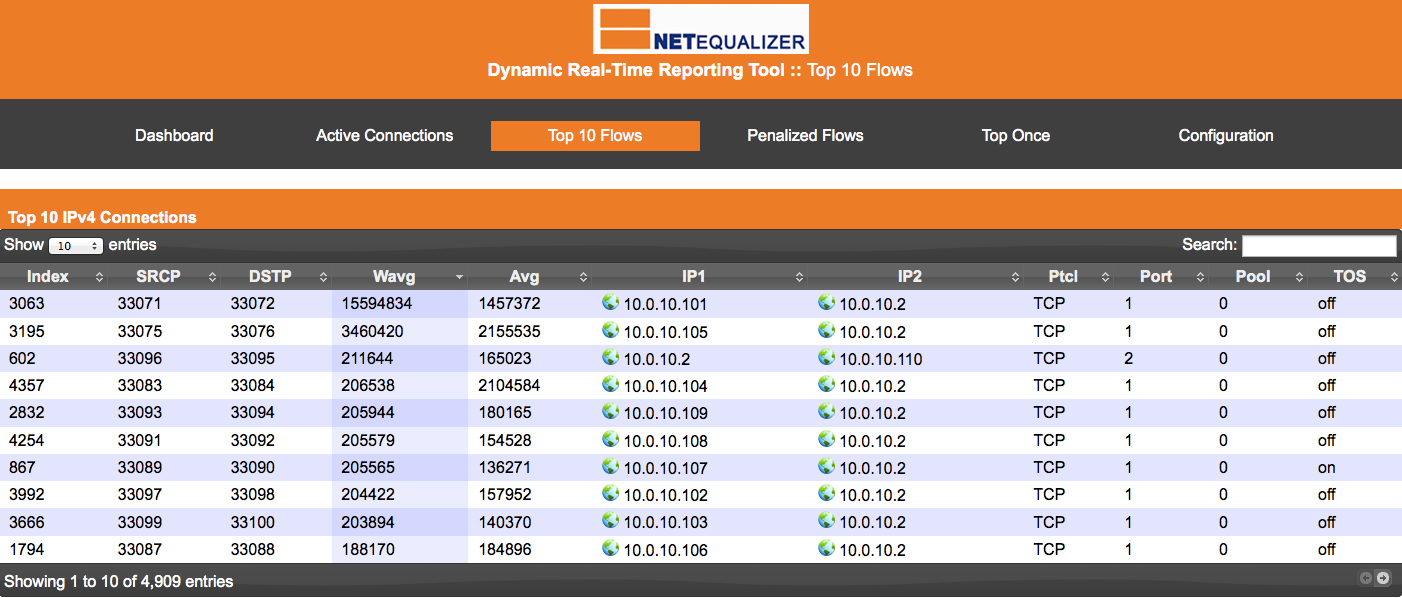
top10

The reporting associated with each of these features is much improved and more interactive than that of the standard View Active Connections report. Here are just some of the things you can do:

* View a dashboard of all your active pools and how much usage they are currently experiencing.
* Filter your Active Connections table by IP.
* Look up the country code associated with an IP address.
* See a total of bandwidth usage for a particular IP address for both up and down connections.
* Sort your Active Connections table by any column.
* See a top 10 offenders list which shows the IP addresses currently using the most bandwidth.
* Display the current status of all penalized connections. Use this interface to filter penalties based on IP and see whether a connection is being penalized.
* And more!

To access RTR on your NetEqualizer, go to the dashboard and click the “Dynamic RTR” icon at the top.

dynamicrtr

We are always brainstorming and adding features to RTR. If you have ideas on how RTR could be improved, please email us!

RTR is free to customers with valid NetEqualizer Software and Support who have systems capable of running 7.0+. If you are not current with NSS or have questions about your current unit, contact us today!

sales@apconnections.net
-or-
toll-free U.S. (800-918-2763),
worldwide (303) 997-1300 x. 103


10 Year Anniversary Celebration Still Going Strong!APconnections 10 Year Celebration

This is the last month of our 10 Year Anniversary Celebration and, as part of it, we will be donating $25 to one of four charities of the buyer’s choice for each unit sold from now until August 31, 2013. Address your bandwidth issues while helping a great cause! Contact us today!

sales@apconnections.net


Customers in the News: APconnections Sponsors Golf Tournament145x145-green

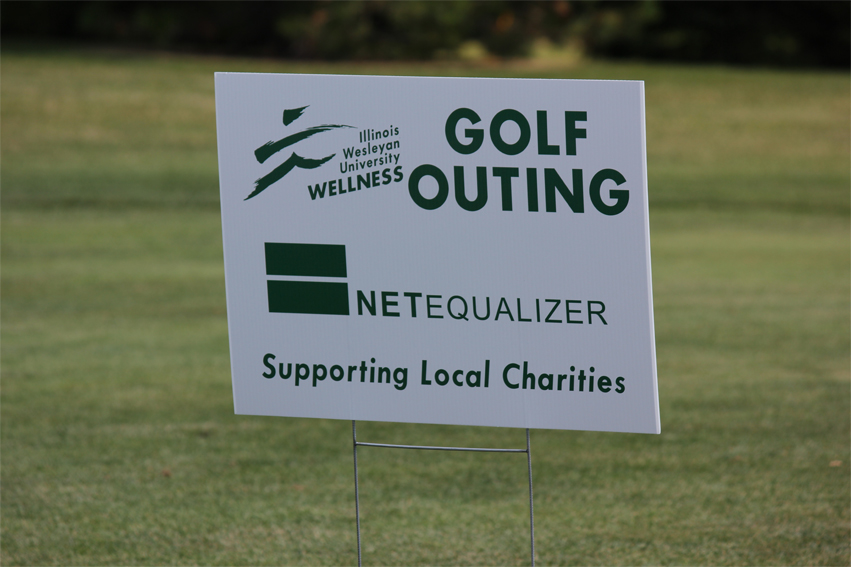
Last month, APconnections was honored to sponsor a hole at the Illinois Wesleyan 19th Annual Wellness Golf Outing. Proceeds were donated to an Illinois Wesleyan educational campaign called Transforming Lives.

We love it when we can support our customers’ charitable initiatives. Illinois Wesleyan has been a NetEqualizer customer since 2008!

Here is a picture of our hole:

neteqgolf


Software Update 7.3 Released

We recently released Software Update 7.3c.  We recommend that you take this upgrade if either of the following apply to you:

* If you are running 7.0+ with sustained loads of >=250Mbps.  We have fixed a has table issue that appeared at high volumes under intense sustained loads.
* If you are using our RTR on 7.1 and would like to use the Chrome or Safari browse, we have now fixed the issue that was causing these browsers not to work well with RTR.  We have also sped up the Active Connections and Top 10 reports.

Software Update 7.3c is free to customers with valid NetEqualizer Software and Support. If you are not current with NSS, contact us today!

sales@apconnections.net
-or-
toll-free U.S. (800-918-2763),
worldwide (303) 997-1300 x. 103


Fall 2013 Release Planning

Our fall release planning continues! We anticipate a release for the late October/early November time frame. Look for further enhancements to our Real-Time Reporting (RTR), including a new VLAN report, additional Pools reporting, more information on penalties, and expanded caching ability for more types of files and video.

We also plan GUI updates to the following:

* Show all rules for an IP – be able to look up all associated rules for a given IP or subnet.
* Choose units for dashboard display – multiple options for bandwidth units beyond bytes/sec.
* See the top 10 offenders – this is already a feature in our Real-Time Reporting tool, but it will soon be available to all.
* Priority by whois – Give priority to connections based on a whois lookup of their IP.
* And more!

We are finalized content in the next several weeks. If you have an idea for us on what you would like to see, email sales@apconnections.net with your idea.

These features will be free to customers with valid NetEqualizer Software and Support. If you are not current with NSS, contact us today!

sales@apconnections.net
-or-
toll-free U.S. (800-918-2763),
worldwide (303) 997-1300 x. 103


Best Of The Blog

Is a Balloon Based Internet Service a Threat to Traditional Cable and DSL?

By Art Reisman – CTO – APconnections

I recently read an article regarding Google’s foray into balloon based Internet services.

This intriguing idea sparked a discussion with some of the engineers at a major satellite internet provider on the same subject. They, as well as myself, were somewhat skeptical at the feasibility of this balloon idea. Could we be wrong? Obviously, there are some unconventional obstacles with bouncing Internet signals off balloons, but what if those obstacles could be economically overcome?

First lets look at the practicalities of using balloons to beam Internet signals from ground based stations to consumers.

Advantages over satellite service

Latency

Satellite Internet, the kind used by Wild Blue, usually comes with a minimum of a 1 second delay, sometimes more. The bulk of this signal delay is due to the distance required for a stationary satellite, 22,000 miles…

Photo Of The Month

IMG_1453
Summer Gardens
Gardeners in Colorado rush to grow all they can while the sun is shining and the snow is hibernating. Frequent afternoon rain showers help make the crops abundant. The only thing to fret is golf-ball-sized hail which can destroy your hard work. This is one of our staff member’s cat, Merlot, hanging out in the garden.

Is a Balloon Based Internet Service a Threat to Traditional Cable and DSL?


Update:


Looks like this might be the real deal. A mystery barge in San Francisco Bay owned by Google


I recently read an article regarding Google’s foray into balloon based Internet services.

This intriguing idea sparked a discussion with some of the engineers at a major satellite internet provider on the same subject. They, as well as myself, were somewhat skeptical at the feasibility of this balloon idea. Could we be wrong? Obviously, there are some unconventional obstacles with bouncing Internet signals off balloons, but what if those obstacles could be economically overcome?

First lets look at the practicalities of using balloons to beam Internet signals from ground based stations to consumers.

Advantages over satellite service

Latency

Satellite Internet, the kind used by Wild Blue, usually comes with a minimum of a 1 second delay, sometimes more. The bulk of this signal delay is due to the distance required for a stationary satellite, 22,000 miles.

A balloon would be located much closer to the earth, in  the atmosphere at around 2 to 12 miles up. The delay at this distance latency is just a few milliseconds.

Cost

Getting a basic stationary satellite into space runs at a minimum 50 million dollars, and perhaps a bit less for a low orbiting non stationary satellite.

Balloons are relatively inexpensive compared to a satellite. Although I don’t have exact numbers on a balloon, the launch cost is practically zero, a balloon carries its payload without any additional energy or infrastructure, the only real cost is the balloon, the payload, and ground based stations. For comparison purposes let’s go with 50,000 per balloon.

Power

Both options can use solar, orienting a balloon position with solar collectors might require 360 degree coverage; however as we will see a balloon can be tethered and periodically raised and lowered, in which case power can be ground based rechargeable.

Logistics

This is the elephant in the room. The position of a satellite in time is extremely predictable. Even for satellites that are not stationery, they can be relied on to be where they are supposed to be at any given time. This makes coverage planning deterministic. Balloons on the other hand, unless tethered will wonder with very little future predictability.

Coverage Range

A balloon at 10,000 feet can cover a Radius on the ground of about 70 miles.  A stationary satellite can cover an entire continent.  So you would need a series of balloons to cover an area reliably.

Untethered

I have to throw out the idea of untethered high altitude balloons. They would wander all over the world , and crash back to earth in random places. Even if  it was cost-effective to saturate the upper atmosphere with them, and pick them out when in range for communications, I just don’t think NASA would be too excited to have 1000’s of these large balloons in unpredictable drift patterns .

Tethered

As crazy as it sounds, there is a precedent for tethering a communication balloon to a 10,000 foot cable. Evidently the US did something like this to broadcast TV signals into Cuba. I suppose for an isolated area where you can hang out offshore well out-of-the-way of any air traffic, this is possible

High Density Area Competition

So far I have been running under the assumption that the balloon based Internet service was an alternative to satellite coverage which finds its niche exclusively in rural areas of the world.  When I think of the monopoly and cost advantage existing carriers have in urban areas, a wireless service with beamed high speeds from overhead might have some staying power. Certainly there could be some overlap with rural users and thus the economics of deployment become more cost-effective. The more subscribers the better. But I do not see urban coverage as a driving business factor.

Would the consumer need a directional Antenna?

I have been assuming all along that these balloons would supply direct service to the consumer. I would suspect that some sort of directional antenna pointing at your local offshore balloon would need to be attached to the side of your house.  This is another reason why the balloons would need to be in a stationary position

My conclusion is that somebody, like Google, could conceivably create a balloon zone off of any coastline with a series of Balloons tethered to barges of some kind. The main problem assuming cost was not an issue, would be the political ramifications of  a plane hitting one of the tethers. With Internet demand on the rise, 4g’s limited range, and the high cost of laying wires to the rural home, I would not be surprised to see a test network someplace in the near future.

Tethered Balloon ( Courtesy of Arstechnica article)

Revenge of the Spammed


By
Art Reisman

CTO http://www.apconnections.net

This morning, after spending the customary five to 10 minutes filtering good e-mail from bad e-mail,  I decided I was no longer going to be  a victim of spam. I started thinking of  ways to  counter it.  Something beyond the traditional filtering mechanisms that are just a preventitive defense.  Although not in line with my core beliefs, I wanted to take revenge on spam, make it suffer and feel pain.

The word “virus” in the computer world is always associated with negative connotations. Why is that?  In the natural world, we now know there are good germs and bad germs, invasive species, and beneficial species, etc.

So why can’t we create a good germ for the cyberworld, a germ that would work for us to combat spam?

I think we can.

My first idea is to create a little automated bot that will respond and engage my incoming unsolicited spamming friends into a frivolous black hole of wasted time.

When I install my new tool into my e-mail reader, it will replace the  “spam” button with a new button called “attack” or  “revenge” or maybe something a little less macho and aggressive. I’ll leave the final button name choice to the focus group. Once the button is  pressed the wheels will go in motion,  as my bot comes alive.

For starters,  it will respond with a reasonable non-specific inquiry back to the spammer. (Yes,  I’ll have to be smart and change-up my responses from a vast database so they never know they are talking to a bot.)

For example, Spammer would start with a subject line something like:

” Your Credit Score May Have Been Updated.”

My Bot would respond with:

“Thank you for sending me this information about your services.

Can you kindly send me some more information on your pricing and terms of service.  Also, I will gladly consider buying if you can send me three references from satisfied customers.”

So you see where this is going…

The ultimate goal would be to replicate my tool to the entire world of law-abiding citizens.  I alone could not deter Spammer with my lone bot, but if this idea caught on, spammers would get inundated with time-wasting responses, leading them down a path of slow painful spammer starvation.  They would relentlessly squander all of their energy searching in vain for an actual human response.

I suppose there are  all sorts of flaws in my plan, so don’t ask me for the final commercial version just yet, at least until I have more time to vet the idea and the prototype.

It should be known that there is a precedent in this area.  Back in a time before the Internet, unsolicited phone calls were reaching a peak in the early 1990’s. I was actually involved as an arms supplier in this  previous war.  I was the system architect for AT&T’s  business class inbound call answering servers. In the wrong hands, these servers could also be used for robotic outbound dialing.

We had labs set up where we could direct our calling servers to make 1000’s of calls an hour, using 128 phone lines.  Normally a test set up involved having two servers call each other to create a load. One machine would call the other, and once the call was established, talking bots on each machine would engage each other ad nauseam,  in a dance of prompts and automated touch tone responses.

In one case we (I)  fat-fingered an internal number in the outbound calling program. The end result was that I  caused  a  test machine to call out to a real phone, a colleague of mine, rendering his phone completely useless for a half day. I became  sort of folk hero within the group when I boldly admitted my mistake and took credit for it.

The urban legend of the time, and people swore this story was true, was that some tech working at one of the AT&T resellers took one of our boxes and turned it on any unsolicited business caller with a little message script that would go start by saying,

“hello, I am an automated customer ” and then would ask them a bunch of questions about their business and hang up.

He would direct 64 calls at time into the business call center tying up all their agents.

NetEqualizer News: July 2013


July 2013

Greetings!

Enjoy another issue of NetEqualizer News! This month, we discuss our new NetEqualizer Leasing Program and talk about improvements to both our GUI and our Dynamic Real-Time Reporting tool. As always, feel free to pass this along to others who might be interested in NetEqualizer News.

A message from Art…
Art Reisman, CTO – APconnections

I have been focused on technical projects lately, such as our 64-bit release, art_smallour new Dynamic Real-Time Reporting, and also some improvements in our NetEqualizer Caching Option (NCO). While taking a break from thinking about technology, I became involved in a leasing deal for a customer acquiring a NetEqualizer, and thought – we can do that better!

So… this month we are introducing the NetEqualizer Leasing Program, offered directly from APconnections on a trial basis. If you find this of value, we will keep this program around. Leasing gives you another way to manage your cash flow and capital expenditures, so that you can solve your network congestion issues with a NetEqualizer today.

We love it when we hear back from you – so if you have a story you would like to share with us of how we have helped you, let us know. Email me directly at art@apconnections.net. I would love to hear from you!

Lease a NetEqualizer!

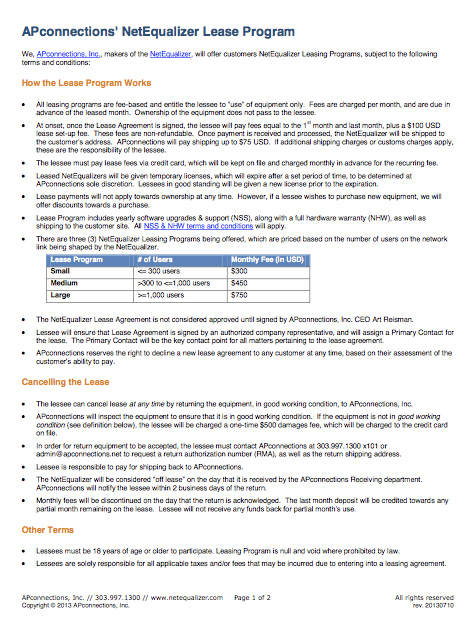
We are happy to announce a brand new way to get all the benefits a NetEqualizer can provide without having to front the initial cost: the NetEqualizer Leasing Program!

How it workslease

NetEqualizer offers three leasing programs which vary based on the number of users in your network. Each program has an associated monthly fee that includes licensing, software updates, and support. Here are the prices of the three programs:

Small (less than 300 users): $300/mo.
Medium (300 to 1000 users): $450/mo.
Large (more than 1000 users): $750/mo.

Lessees can cancel at anytime provided the unit is in good condition once it is sent back.

This is a great way to get a NetEqualizer into your network for a low monthly fee and very little money upfront.

For complete details, take a look at our Leasing Program Agreement here. There is also information located on our How to Buy page.

If you have any questions about our NetEqualizer Leasing Program, contact us today at:

sales@apconnections.net


Reminder: 10 Year Anniversary Celebration!APconnections 10 Year Celebration

As part of our 10 Year Celebration, we will be donating $25 to one of four charities of the buyer’s choice for each unit sold from now until August 31, 2013. Address your bandwidth issues while helping a great cause! Contact us today!

sales@apconnections.net


New GUI Features Coming This Fall!

Over the next few months, we’ll be adding some requested features to the NetEqualizer GUI to help improve user experience and increase functionality.

Here are some of the changes you are likely to see:
* Show all rules for an IP – be able to look up all associated rules for a given IP or subnet.
* Choose units for dashboard display – multiple options for bandwidth units beyond bytes/sec.
* See the top 10 offenders – this is already a feature in our Dynamic Real-Time Reporting tool, but it will soon be available to all.
* Priority by whois – Give priority to connections based on a whois lookup of their IP.
* And more!

We are continuing to invest in adding features to the new GUI, based on user requests and all the positive feedback we have received. We are excited to continue our commitment to providing you with the best tools to manage your network. Now that many of you have used the new GUI for 10+ months, let us know if there is something that you would like to see included this fall!

These features will be free to customers with valid NetEqualizer Software and Support. If you are not current with NSS, contact us today!

sales@apconnections.net

-or-

toll-free U.S. (888-287-2492),

worldwide (303) 997-1300 x. 103


Best Of The Blog

QoS Over the Internet: Is it Possible? Five Must-Know Facts

By Art Reisman – CTO – APconnections

I had an inquiry from a potential customer yesterday asking if we could monitor their QoS. I was a bit miffed as to what to tell them. At first, the question struck me as if they’d asked if we can monitor electrons on their power grid. In other words, it was a legitimate question in a sense, but of what use would it be to monitor QoS? I then asked him why he had implemented QoS in the first place. How did he know he needed it?

After inquiring a bit deeper, I also found out this customer was using extensive VPNs to remote offices over DSL internet circuits. His WAN traffic from the remote offices was sharing links with regular Internet data traffic, and all of it was traversing the public Internet. Then it hit me – he did not realize his QoS mechanisms were useless outside of his internal network…

Photo Of The Month

pb4
Dog Days of Summer
One of our friends recently adopted a dog from an animal shelter, as she wanted a companion animal to play with her hyperactive terrier puppy. Here they are, already mimicking each other on Day 2 after the adoption. I am sure that they will both enjoy their new life together during these hot, dog days of summer!

Five Things to Consider When Building a Commercial Wireless Network


By Art Reisman, CTO, APconnections,  www.netequalizer.com

with help from Sam Beskur, CTO Global Gossip North America, http://hsia.globalgossip.com/

Over the past several years we have provided our Bandwidth Controllers as a key component in many wireless networks.  Along the way we have seen many successes, and some not so successful deployments.  What follows are some key learnings  from our experiences with wireless deployment,

1) Commercial Grade Access Points versus Consumer Grade

Commercial grade access points use intelligent collision avoidance in densely packed areas. Basically, what this means is that they make sure that a user with access to multiple access points is only being serviced by one AP at a time. Without this intelligence, you get signal interference and confusion. An analogy would be if  you asked a sales rep for help in a store, and two sales reps start talking back to you at the same time; it would be confusing as to which one to listen to. Commercial grade access points follow a courtesy protocol, so you do not get two responses, or possibly even 3, in a densely packed network.

Consumer grade access points are meant to service a single household.  If there are two in close proximity to each other, they do not communicate. The end result is interference during busy times, as they will both respond at the same time to the same user without any awareness.  Due to this, users will have trouble staying connected. Sometimes the performance problems show up long after the installation. When pricing out a solution for a building or hotel be sure and ask the contractor if they are bidding in commercial grade (intelligent) access points.

2) Antenna Quality

There are a limited number of frequencies (channels) open to public WiFi.  If you can make sure the transmission is broadcast in a limited direction, this allows for more simultaneous conversations, and thus better quality.  Higher quality access points can actually figure out the direction of the users connected to them, such that, when they broadcast they cancel out the signal going out in directions not intended for the end-user.  In tight spaces with multiple access points, signal canceling antennas will greatly improve service for all users.

3) Installation Sophistication and Site Surveys

When installing a wireless network, there are many things a good installer must account for. For example,  the attenuation between access points.  In a perfect world  you want your access points to be far enough apart so they are not getting blasted by their neighbor’s signal. It is okay to hear your neighbor in the background a little bit, you must have some overlap otherwise you would have gaps in coverage,  but you do not want them competing with high energy signals close together.   If you were installing your network in a giant farm field with no objects in between access points, you could just set them up in a grid with the prescribed distance between nodes. In the real world you have walls, trees, windows, and all sorts of objects in and around buildings. A good installer will actually go out and measure the signal loss from these objects in order to place the correct number of access points. This is not a trivial task, but without an extensive site survey the resultant network will have quality problems.

4) Know What is Possible

Despite all the advances in wireless networks, they still have density limitations. I am not quite sure how to quantify this statement other than to say that wireless does not do well in an extremely crowded space (stadium, concert venue, etc.) with many devices all trying to get access at the same time. It is a big jump from designing coverage for a hotel with 1,000 guests spread out over the hotel grounds, to a packed stadium of people sitting shoulder to shoulder. The other compounding issue with density is that it is almost impossible to simulate before building out the network and going live.  I did find a reference to a company that claims to have done a successful build out in Gillette Stadium, home of the New England Patriots.  It might be worth looking into this further for other large venues.

5) Old Devices

Old 802.11b devices on your network will actually cause your access points to back off to slower speeds. Most exclusively-b devices were discontinued in the mid 2000’s, but they are still around. The best practice here is to just block these devices, as they are rare and not worth bringing the speed of your overall network down.

We hope these five (5) practical tips help you to build out a solid commercial wireless network. If you have questions, feel free to contact APconnections or Global Gossip to discuss.

Related Article:  Wireless Site Survey With Free tools

The Rebirth of Wired Bandwidth


By Art Reisman. CTO http://www.netequalizer.com

As usual marketing expectations for internet speed have out-run reality; only this time reality is having a hard time catching up.

I am starting to get spotty yet reliable reports, from sources at some of the larger wireless carriers, that the guys in the trenches charged with supporting wireless technology are about ready to throw in the towel.  The reports are coming in from technicians who work with the large service providers.

No, I am not predicting the demise of wireless bandwidth and devices, but I am claiming we are at their critical saturation point. In the near future we will likely see only small incremental improvements in wireless data speeds.

The common myth with technology, especially in the first few decades, is that improvements are endless and infinite.  Yes, the theory is validated with technologies that are relatively new and moving fast, but the physical world eventually puts the brakes on.

For example, air travel saw huge jumps in comfort and speed for a 20 year span from the 1930’s to the 1950’s, culminating in jet travel across oceans.  While trans-ocean travel became a reality about 50 years ago, since that time there have been no improvements in speed. The Concorde was just not practical; as a result we have seen no net improvements in jet travel speed in 50 years.

Well, the same goes for wireless technology in 2013. The airwaves are saturated, the frequencies can only carry so much bandwidth.  Perhaps there will be one last gasp of innovation, similar to WDM on wired networks, but the future of high-speed computing will require point-to-point wires.  For this reason, I am still holding onto my prediction that we will see plugins for your devices start to pop up again as an alternative and convenience to wireless in the near future.

Related posts:

The truth about the wireless bandwidth crises This article assumes that there is a payment problem with the cost of paying for the technology.

ISP speed claim dilemma.

NetEqualizer News: June 2013


June 2013

Greetings!

Enjoy another issue of NetEqualizer News! This month, we preview our new Dynamic Real-Time Reporting Tool, announce our quarterly FlyAway Contest winner, celebrate our 10th Anniversary, and discuss our upcoming Technical Seminar! As always, feel free to pass this along to others who might be interested in NetEqualizer News.

A message from Art…
Art Reisman, CTO – APconnections

Ten years ago this summer I was feverishly developing the original DPI version of the NetEqualizer, and gettingNetEQ_story_icon ready to release it to customers. It is both humbling and gratifying to be a part of growing my big idea into the company that we are today. If you want to see into the mind of an entrepreneur during start up, you can read all about my journey and how the technology was developed in “The Story of NetEqualizer”, available as a PDF or eBook.

We love it when we hear back from you – so if you have a story you would like to share with us of how we have helped you, let us know. Email me directly at art@apconnections.net. I would love to hear from you!

Software Update 7.1: Dynamic Real-Time Reporting is Here!

We are excited to announce that our built-in version of the Dynamic Real-Time Reporting (RTR) tool is ready for release to all customers on Software Update 7.0+!

One of the things that differentiates the NetEqualizer from other monitoring and shaping tools is that we have the actual data for every user accurately updated by the second.

The reporting tools on most other devices tend to slog along and show you aggregate usage of 5 minute averages. Even the charge back mechanisms that ISPs use to figure out if you are over your allotted bandwidth do 95th percentile sampling – meaning they estimate your usage from sporadic sampling.

One thing we have not been good at, until now, is making this wealth of real data available to the end user in a nice organized usable presentation.

As of this week that is going to change.

In our 7.1 Software Update we have upgraded to a more robust Apache Web server shipping with every system. This has allowed us to take some of real time data and offer the administrator some nicer tools. For example, you can:

– View active connections running through your NetEqualizer and search or sort them however you like.
– Figure out the country associated with a specific IP address.
– View the top 10 flows running through your network – those that are using the most bandwidth.

top10

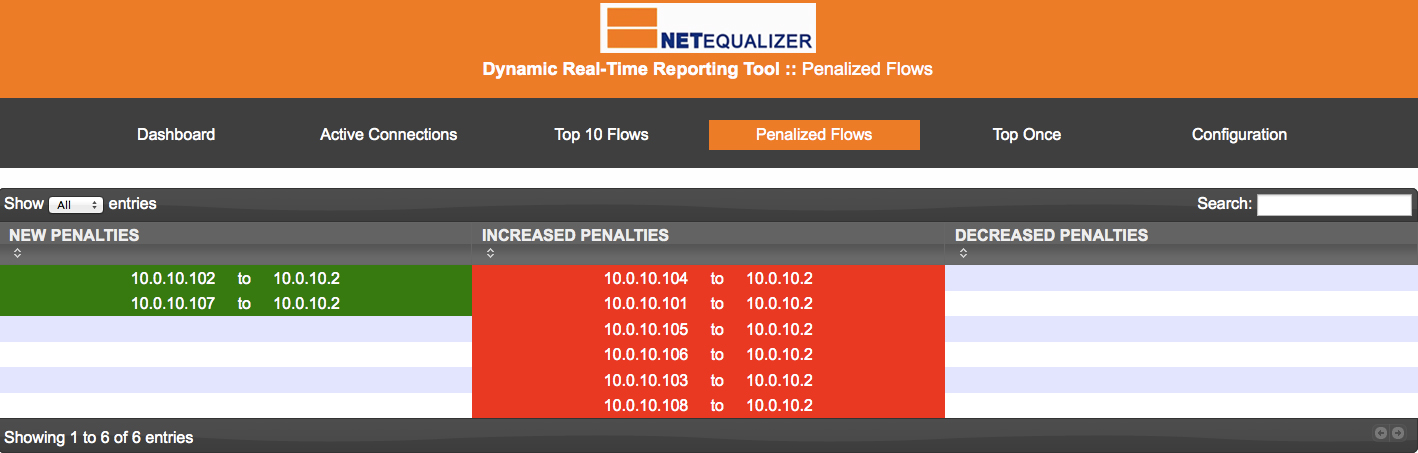
– View the state of all currently penalized flows. See which flows are newly penalized, which have had their penalties increased, and which have had their penalties decreased.

flows

– View, search and sort all running processes to easily spot problems with your device.

Stay tuned to NetEqualizer News for updates on new features!

The RTR tool is free to customers with valid NetEqualizer Software and Support who are running version 7.0+. If you are not current with NSS, contact us today!

sales@apconnections.net

-or-

toll-free U.S. (888-287-2492),

worldwide (303) 997-1300 x. 103


Fall Technical Seminar

We are starting to plan for our next Technical Seminar!

This popular seminar brings our CTO, Art Reisman, directly to you. In this half day event, Art explores the NetEqualizer technology in detail, and answers your technical questions. We will also be discussing and answering questions about our NetGladiator security appliance! Lunch will be provided to all attendees.

In this Technical Seminar, you will experience the following:neteq seminar logo with border
  • Deep dive on NetEqualizer bandwidth shaping
  • Learn how NetEqualizer Caching Option works
  • See the new Software Update (7.1)
  • Walk through a NetEqualizer Live Demo
  • Get your technical questions answered
  • Participate in a brainstorming session on future direction of bandwidth control
  • Learn more about the NetGladiator web application security appliance

Please note that this is NOT a marketing presentation – it is run by & created for techies!

Whether you are an existing customer or just starting to think about bandwidth shaping, come learn more about the NetEqualizer technology and share your experiences with other customers.

We are also currently looking for a location to host the seminar sometime around October of this year. If you or your organization is interested, please contact us at:

sales@apconnections.net


And the FlyAway Contest Winner Is…

Every few months, we have a drawing to give  away two round-trip domestic airline tickets from Frontier Airlines to one lucky person who’s recently tried out our online NetEqualizer demo.

The time has come to announce this round’s winner.

And the winner is…40

Terrence Shipclark of Humber College.

Congratulations, Terrence!

Please contact us within 30 days (by July 17, 2013) at:

admin@apconnections.net
-or-
303-997-1300

to claim your prize!


10 Year Anniversary Celebration – All Summer Long!

We are celebrating 10 years in business this summer, thanks to you, our loyal customers! Our first NetEqualizer sale was a CD version, way back on July 13th, 2003. We have come a long way since then. We have rolled out NetEqualizer appliances to offer a consistent, standard, supportable framework to make it easy for you to own and operate your NetEqualizer.APconnections 10 Year Celebration

We have built out our core technology, equalizing behavior-based shaping, and added tons of features along the way – such as our Professional Quota API, CALEA, the NetEqualizer Caching Option (NCO), NetEqualizer Directory Integration (NDI), and a new GUI – just to name a few.

And we have leaped into the web application security world, introducing our NetGladiator IPS appliances last year.

Thousands of installations later, NetEqualizers are deployed across six (6) continents in small and large businesses, universities, schools, libraries, and internet providers.

So, as part of our 10 Year Celebration, we will be donating $25 to one of four charities of the buyer’s choice for each unit sold from now until August 31, 2013. The charities are:

1) United States Fund for UNICEF

(http://www.unicefusa.org)

2) Habitat for Humanity

(http://www.habitat.org)

3) Doctors Without Borders

(http://www.doctorswithoutborders.org)

4) Global Hunger Project

(http://www.thp.org)

Contact us today at:

sales@apconnections.net

-or-

toll-free U.S. (800-918-2763),

worldwide (303) 997-1300 x. 103


Best Of The Blog

CALEA: A Look Back and Forward

By Art Reisman – CTO – APconnections

It has been 4 years since the most recent round of CALEA laws took effect. At the time, our phones rang off the hook for several days with calls from various small ISPs worrying that they were going to be shut down if they did not invest in a large expensive CALEA compliant device.

Implementation of the law was open to interpretation.

Confusion over what CALEA was, stemmed from the fact that the CALEA laws themselves do not contain a technical specification. In essence, they are just laws. Suppose the Harvard Law school became the front end design team for all projects in Harvard’s engineering school. Lawyers write laws,  not engineering specifications. And so it was with CALEA, congress wrote a well intended law, but the implementation and enforcement part had to be interpreted. The FBI took the lead and wrote an extremely detailed specification as to what they wanted. The specification covered every scenario possible and thus the scope was costly to implement. Vendors willingly took the complex FBI specification to heart as part of the actual law, and built out high dollar CALEA certified devices. As vendors will do, their sales teams ran with it as gospel and spread fear in order to sell expensive equipment with large margins. Fortunately calmness prevailed at some point, and the FBI consultants worked with us and some of the smaller ISPs on a reasonable scaled down version of their CALEA requirements.

Ironically, even the current law has now become problematic for the FBI and they are requesting additional requirements.

The complexity of implementing the new CALEA laws are a reflection of the way we communicate with the Internet.

Prior to the Internet, the wire tap precedent for old phone systems was much simpler to implement. And, I suspect this simplicity played a role in the surprise confusion implementing an updated law. Historically a wire tap was just a matter of arriving at the central office with a search warrant and a tapping device, a wire splice, then listening in on a customer phone call. The transition of the law to implementation was fairly obvious…

Photo Of The Month

photo(12)
World Series of Poker – Las Vegas, Nevada
Each summer, thousands of poker players from all over the world descend on the desert oasis of Las Vegas, Nevada for the World Series of Poker. The WSOP consists of over 50 bracelet events and culminates in a Main Event that annually turns out to be the biggest tournament of the year. This picture was taken recently by a staff member who is staying in Vegas for
the summer and participating in some of the events.

A Novel Idea on How to Cache Data Completely Transparently


By Art Reisman

Recently I got a call from a customer claiming our Squid proxy was not retrieving videos from cache when expected.

This prompted me to set up a test in our lab where I watched  four videos over and over. With each iteration, I noticed that the proxy would  sometimes go out and fetch a new copy of a video, even though the video was already in the local cache, thus confirming the customer’s observation.

Why does this happen?

I have not delved down into the specific Squid code yet, but I think It has to do with the dynamic redirection performed by YouTube in the cloud, and the way the Squid proxy interprets the URL.  If you look closely at YouTube URLs, there is a CGI component in the name, the word “what” followed by a question mark “?”.  The URLs  are not static. Even though I may be watching the same YouTube on successive tries, the cloud is getting the actual video from a different place each time, and so the Squid proxy thinks it is new.

Since caching old copies of data is a big no-no, my Squid proxy, when in doubt, errors on the side of caution and fetches a new copy.

The other hassle with using a proxy caching server  is the complexity of  setting up port re-direction (special routing rules). By definition the Proxy must fake out the client making the request for the video. Getting this re-direction to work requires some intimate network knowledge and good troubleshooting techniques.

My solution for the above issues is to just toss the traditional Squid proxy altogether and invent something easier to use.

Note: I have run the following idea  by the naysayers  (all of my friends who think I am nuts), and yes, there are still  some holes in this idea. I’ll represent their points after I present my case.

My caching idea

To get my thought process started, I tossed all that traditional tomfoolery with re-direction and URL name caching out the window.

My caching idea is to cache streams of data without regard to URL or filename.  Basically, this would require a device to save off streams of characters as they happen.  I am already very familiar with implementing this technology; we do it with our CALEA probe.  We have already built technology that can capture raw streams of data, store, and then index them, so this does not need to be solved.

Figuring out if a subsequent stream matched a stored stream would be a bit more difficult but not impossible.

The benefits of this stream-based caching scheme as I see them:

1) No routing or redirection needed, the device could plugged into any network link by any weekend warrior.

2) No URL confusion.  Even if a stream (video) was kicked off from a different URL, the proxy device would recognize the character stream coming across the wire to be the same as a stored stream in the cache, and then switch over to the cached stream when appropriate, thus saving the time and energy of fetching the rest of the data from across the Internet.

The pure beauty of this solution is that just about any consumer could plug it in without any networking or routing knowledge.

How this could be built

Some rough details on how this would be implemented…

The proxy would cache the most recent 10,000 streams.

1) A stream would be defined as occurring when continuous data was transferred in one direction from an IP and port to another IP and port.

2) The stream would terminate and be stored when the port changed.

3) The server would compare the beginning parts of new streams to streams already in cache, perhaps the first several thousand characters.  If there was a match, it would fake out the sender and receiver and step in the middle and continue sending the data.

What could go wrong

Now for the major flaws in this technology that must be overcome.

1) Since there is no title on the stream from the sender, there would always be the chance that the match was a coincidence.  For example, an advertisement appended to multiple YouTube videos might fool the caching server. The initial sequence of bytes would match the advertisement and not the following video.

2) Since we would be interrupting a client-server transaction mid-stream, the server would have to be cut-off in the middle of the stream when the proxy took over.  That might get ugly as the server tries to keep sending. Faking an ACK back to the sending server would also not be viable, as the sending server would continue to send data, which is what we are trying to prevent with the cache.

Next step, (after I fix our traditional URL matching problem for the customer) is to build an experimental version of stream-based caching.

Stay tuned to see if I can get this idea to work!

APconnections 10 Year Anniversary Celebration – All Summer Long!


We are celebrating 10 years in business this summer, thanks to you, our loyal  customers!  Our first NetEqualizer sale was a CD version, way back on July 13th, 2003.  As part of APconnections’ 10 Year Celebration, we will be donating $25 to one of four charities of the buyer’s choice for each NetEqualizer or NetGladiator sold from now until August 31, 2013.

We selected charities that are all rated B+ or above by CharityWatcAPconnections 10 Year Celebrationh.  The charities are operate on a global basis (like us!) and focus on one of the following: International Relief & Development, Homelessness & Housing, or Hunger. While we may not have picked your favorite charity, we hope that you agree that these are all worthy causes!

When you place a purchase order between now and August 31st, 2013, you will be asked to pick the charity of your choice for each unit purchased.

The charities, along with descriptions of their mission/vision from their websites are as follows.  You can visit their websites by clicking on their logos or the displayed link:

1) United States Fund for UNICEF   http://www.unicefusa.org
UNICEFThe United Nations Children’s Fund (UNICEF) works in more than 190 countries and territories to save and improve children’s lives, providing health care and immunizations, clean water and sanitation, nutrition, education, emergency relief and more. The U.S. Fund for UNICEF supports UNICEF’s work through fundraising, advocacy and education in the United States. Together, we are working toward the day when ZERO children die from preventable causes and every child has a safe and healthy childhood.

2) Habitat for Humanity    http://www.habitat.orgHabitat for Humanity
Habitat for Humanity believes that every man, woman and child should have a decent, safe and affordable place to live. We build and repair houses all over the world using volunteer labor and donations. Our partner families purchase these houses through no-profit, no-interest mortgage loans or innovative financing methods.

Doctors without Borders3) Doctors Without Borders   http://www.doctorswithoutborders.org
Doctors Without Borders/Médecins Sans Frontières (MSF) works in nearly 70 countries providing medical aid to those most in need regardless of their race, religion, or political affiliation.

The Hunger Project4) Global Hunger Project    http://www.thp.org
The Hunger Project (THP) is a global, non-profit, strategic organization committed to the sustainable end of world hunger. In Africa, South Asia and Latin America, THP seeks to end hunger and poverty by empowering people to lead lives of self-reliance, meet their own basic needs and build better futures for their children.

Thank you for all your support over our first 10 years, we truly appreciate your business! 

We look forward to working with all of you for many more years. 

The World’s Biggest Caching Server


Caching solutions are used in all shapes and sizes to speed up Internet data retrieval. From your desktop keeping a local copy of the last web page viewed, to your cable company keeping an entire library of NetFlix movies,  there is a broad diversity in the scope and size of  caching solutions.

So, what is the biggest caching server out there?  Moreover, if I found the world’s largest caching server, would  it store  just a tiny microscopic subset of the total data  available from the public  Internet?   Is it possible that somebody has actually cached everything Internet? A caching server the size of the Internet seems absurd, but I decided to investigate anyway, and so with an open mind, I set out to find the biggest caching server in the world.  Below I have detailed my research and findings.

As always I started with Google, but not in the traditional sense. If you think about Google, they seem to have every  public page on the Internet indexed. That is a huge amount of data, and I suspect  they are the worlds biggest caching server.  Asserting Google as the worlds largest caching server seems logical , but somewhat hollow and unsubstantiated, my next step was to quantify my assertion.

To figure out how much data is actually stored by Google,  in a weird twist of logic, I figured the best way to estimate the size of the stored data would be to determine what data is not stored in Google.

I would need to find a good way to stumble into some truly random web pages without using Google to find them, and then specifically test to see if Google knew about those pages by  asking Google to search for unique, deep rooted, text strings within those sites.

Rather than ramble too much, I’ll just walk through one of my experiments below.

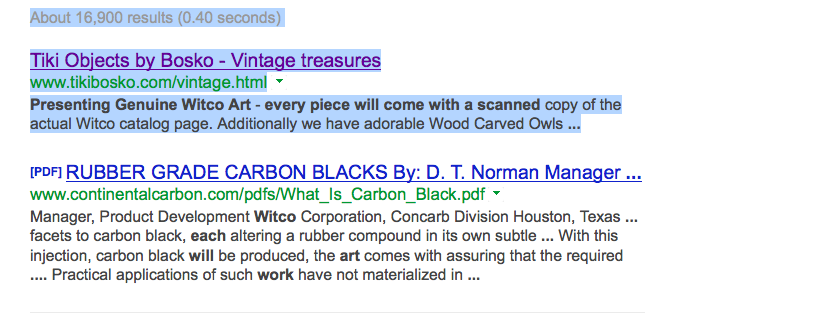
To find a random Web site, I started with  one of those random web site stumblers. As advertised, it took me to a  random  web site titled, “Finest Polynesian Tiki Objects”. From there, I looked for unique text strings on the Tiki site.  The  idea here is find a sentence of text from this site that is not likely to found anywhere but on this site. In essence something deep enough so as not to be a deliberatly indexed title already submitted to google.   I poked around on the Tiki site  and found some seemingly innocuous text on their merchant  site. “Presenting Genuine Witco Art – every piece will come with a scanned”. I put that exact string in my Google search box and presto there it was.

Screen Shot 2013-05-29 at 4.21.04 PM

Wow it looks like Google has this somewhat random page archived and indexed because it came up in my search.

A sample set of two data points is not large enough to extrapolate from and draw conclusions, so I repeated my experiment a few more times and here are more samples of what I found….

Try number two.

Random Web Site

http://www.genarowlandsband.com/contact.php

Search String In Google

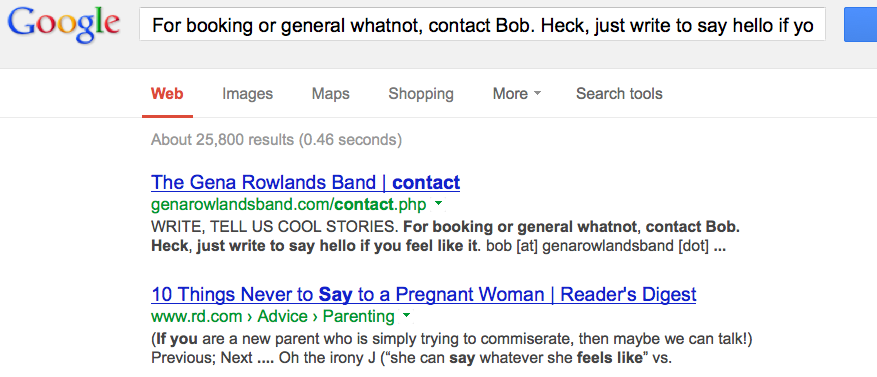
“For booking or general whatnot, contact Bob. Heck, just write to say hello if you feel like it.”

Screen Shot 2013-05-30 at 2.06.35 PM

It worked again, it found the exact page from a search on a string buried deep on the page.

And then I did it again.

Screen Shot 2013-05-30 at 2.18.55 PM

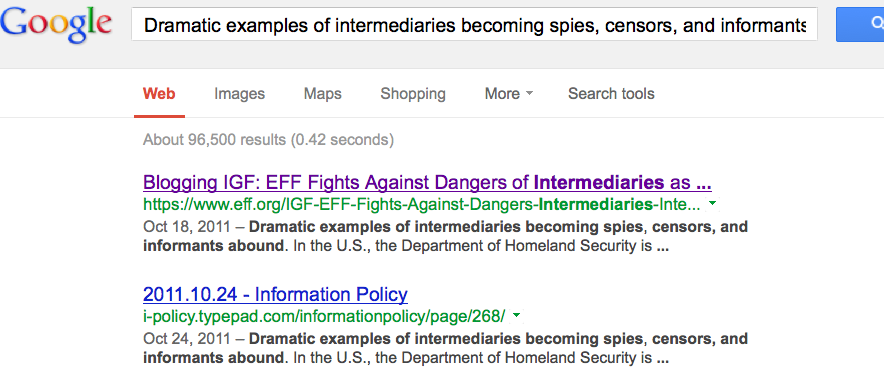
And again Google found the page.

The conclusion is that Google has cached close to 100 percent of the publicly accessible text on the Internet. In fairness to Google’s competitors they also found the same Web pages using the same search terms.

So how much data is cached in terms of a raw number?


There are plenty of public statistics for number of Web sites/pages connected to the Internet, and there is also data detailing the average size of a Web Page, what I have not determined  is how much of the Video, and Images are cached by Google, I do know they are working on image search engines, but for now, to be conservative I’ll base my estimates on Text only.

So roughly there are 15 billion Web Pages, and the average amount of text is 25 thousand bytes. (note most of the Web is Video and Images text is actually a small percentage)

So to get a final number I multiply 15 billion  15,000,000,000 times 25 thousand 25,000 and I get…

375,000,000,000,000 bytes cached…


Notice the name of te site or the band does not appear in my search string, nothing to tip off the google search engine what I am looking for and presto!

Internet Regulation, what is the world coming to ?


A friend of mine just forwarded an article titled “How Net Neutrality Rules Could Undermine the Open Internet”

Basically Net Neutrality advocates are now worried that bringing the FCC in to help enforce Neutrality will set a legal precedent allowing wide-reaching control over other aspects of the Internet. For example, some form of content control extending into gray areas.

Let’s look at the history of the FCC for precedents.

The FCC came into existence to manage and enforce the wireless spectrum,  essentially so you did not get 1000 radio/tv stations blasting signals over each other in every city.  A very necessary and valid government service. Without it, there would be utter anarchy in the airwaves. Imagine roads without traffic signals, or airports without control towers.

At some point in time, their control over frequencies got into content and accessibility mandates.  How did this come about? Simply put, it is the normal progression of government asserting control over a resource. It is what it is, neither good nor bad, just a reflection of a society that looks to government to make things “right”. And like an escaped non-native species in the Hawaiian Islands, it tends to take as much real estate as the ecosystem will allow.

What I do know as a certainty, the FCC, once in the door at regulating anything on the Internet, will continue to grow in order to make things “right” and “fair” during our browsing experience.

At best we can hope the inevitable progression of control by the FCC gets thwarted at every turn allowing us a few more good years of the good old Internet as we know it. I’ll take the current Internet flaws for a few more years while I can.

For more information on non-native species invading Hawaii’s ecosystem, check out this blog, from the Kohala Watershed Partnership.

For an overview of Net Neutrality – check out this Net Neutrality for Dummies Article explaining the act’s possible effects on the everyday internet user.

For a discussion on the possible lawlessness of the FCC’s control over the internet, read this blog entitled “Is the FCC Lawless?”.

NetEqualizer News: May 2013


May 2013

Greetings!

Enjoy another issue of NetEqualizer News! This month, we preview our upcoming integration of our Microsoft Excel Dynamic Real-Time Reporting Tool into NetEqualizer, discuss our new Hotel Management System Integration Offering, and feature a story from a happy NetEqualizer Customer. As always, feel free to pass this along to others who might be interested in NetEqualizer News.

A message from Art…
Art Reisman, CTO – APconnections

art_smallIn May, my thoughts turn to the BolderBoulder, a large 10K running race that I compete in each year. The race has 50,000+ participants, and is split into two, a “people’s race” and  a “professionals race” (International Team Challenge). I compete first and then watch the professionals race, which is usually won by someone from Ethiopia or Kenya, as professionals fly in from all over the world for this race. By May my goal is always to train hard, so that I am at my peak performance on Memorial Day for the run. I work hard to get ready, and plan to run a personal best this year!

We love it when we hear back from you – so if you have a story you would like to share with us of how we have helped you, let us know. Email me directly at art@apconnections.net. I would love to hear from you!

New! Our Hotel Management System Integration Offering

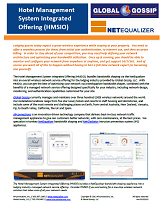
APconnections is excited to announce our Hotel Management System Integrated Offering (HMSIO). We have partnered with Global Gossip, LLC, a leader in the lodging managed network services industry, to offer an end-to-end network managed services solution for our hotel & lodging customers.
hmsio_data_sheet
We are combining strengths to offer NetEqualizer, the best in bandwidth shaping, with Global Gossip’s world class managed network services offering. We now can offer our hotel and lodging customers a full suite of capabilities to manage your wireless network, such as authentication, 24/7/365 support, cloud-based monitoring access, and network design services.

Hotel Management System Integrated Offering has grown organically from Global Gossip’s own use of NetEqualizers in its wireless services solutions in remote places all over the world, including many U.S. National Parks.For more details, check out our HMSIO Data Sheet, or contact us at:

sales@apconnections.net

-or-

toll-free U.S. (888-287-2492),

worldwide (303) 997-1300 x. 103


NetEqualizer Featured Customer

Every so often, NetEqualizer News features a customer who has benefited greatly from our technology and has told us about it!

This month, we feature Gordon College, and Russ Leathe, Director of Network and Computing Services.Here is what Russ had to say about his experience with NetEqualizer:

“We had an incident over the weekend I wanted to tell you about:
gordon_collegeOne of our web servers got hit with a ‘zero-day’ malware. We noticed our bandwidth was completely pegged even though our student population was on, or leaving for Spring-Break (so our bandwidth consumption should have been trending downwards, not upwards). We maintain over 100 servers, 95% of which are in a VM environment. Needless to say, finding the exposed culprit would be like finding the proverbial “needle in a haystack”.Alas, NetEQ to the rescue.
We used NTOP to discover our ‘Top Talkers’.  The Inbound bandwidth was saturated, which was unusual and we pinpointed it to one machine. We quickly wrote a bandwidth rule for that web-server and things returned to normal.
We found the malware and inoculated the server…all within an hour’s time. Normally, this could have taken hours or a few days.

Thanks again… for creating such a great solution for Higher ED!!”

Thanks Russ!

Coming Soon: Microsoft Excel Dynamic Real-Time Reporting Integration

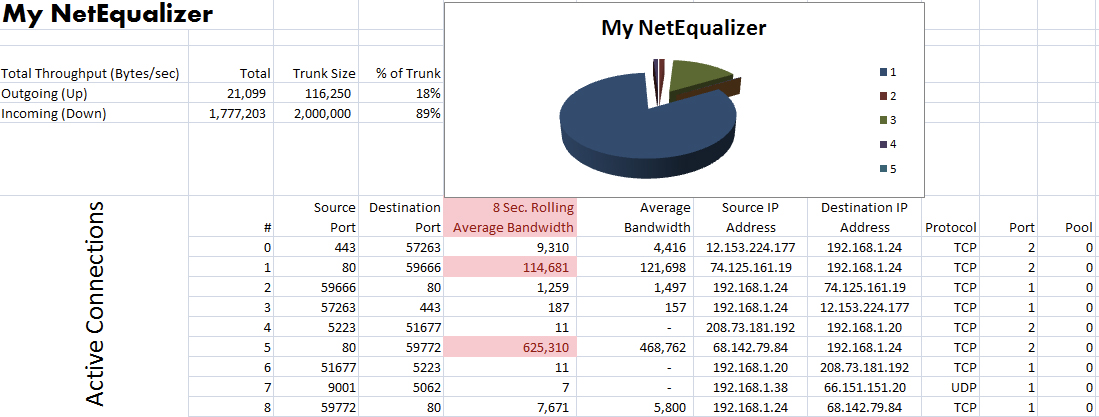
One of our most popular unpublished tools that we release to customers who request it is our Dynamic Real-Time Reporting tool which sends data from your NetEqualizer to Excel so that you can monitor usage from your local PC.

The next generation of this software has arrived.

Coming soon, we will be releasing our built in version of this tool so that you can get the same benefits of its reporting features right on your NetEqualizer. It will require no setup and will be completely web based.

Here is a quick screenshot preview:

micro

You’ll be able to view active connections, connections which are bandwidth hogs, IP to country translation, and more!

This tool is free to customers with valid NetEqualizer Software and Support. If you are not current with NSS, contact us today!

sales@apconnections.net

-or-

toll-free U.S. (888-287-2492),

worldwide (303) 997-1300 x. 103


Best Of The Blog

You Heard it Here First, Our Prediction on How Video Will Evolve to Conserve Bandwidth

By Art Reisman – CTO – APconnections

Editors Note:

I suspect somebody out there has already thought of this, but in my quick Internet search I could not find any references to this specific idea, so I am taking journalistic first claim and unofficial first rights to this idea.

The best example I think of to exemplify efficiency in video, are the old style cartoons,  such as the parody of South Park. If you ever watch South Park animation, the production quality is done deliberately cheesy – very few moving parts with fixed backgrounds. In the South Park case, the intention was obviously not to save production costs. The cheap animation is part of the comedy. That was not always the case, the evolution of this sort of stop animation cartoon was from the early days before computer animation took over the work of human artists working frame by frame. The fewer moving parts in a scene, the less work for the animator. They could re-use existing drawings of a figure and just change the orientation of the mouth in perhaps three positions to animate talking.

Modern video compression tries to take advantage of some of the inherit static data from image to image , such that, each new frame is transmitted with less information.  At best, this is a hit or miss proposition.  There are likely many frivolous moving parts in a back ground that perhaps on the small screen of hand held device are not necessary.

My prediction is we will soon see a collaboration between production of video and Internet transport providers that allows for the average small device video production to have a much smaller footprint in transit.

Some of the basics of this technique would involve…

Photo Of The Month

IMG_0456
This picture of downtown Helsinki, Finland was taken on a recent visit to a customer site by one of our staff members.