NetEqualizer Superhero Animation Helps to Redefine the World of WAN Optimization


Lafayette, CO, February 2, 2010 — APconnections, a leading supplier of plug-and-play bandwidth shaping products and the creator of the NetEqualizer, today announced their new animation available for online viewing.

 Eli Riles, a consulting partner at APconnections, summed it up this way:

“Over the years, we’ve had several clients ask us for an easy way to explain how the NetEqualizer works. Well, our newest NetEqualizer video may be our best response yet. With the help of People Productions of Boulder, we’ve captured the NetEqualizer’s Network Optimization effectiveness in two new videos — one straight to the point and the other a little more detailed.

“So, if you’re looking for an easy way to explain exactly what you’re doing to make your network run smoothly, or are just in need of an overview of how the NetEqualizer works, take a look.”

To view the video: NetEqualizer Superhero Video

What Is Burstable Bandwidth? Five Points to Consider


IMG_20170403_180712

Internet Bursting

Internet Providers continually use clever marketing analogies to tout their burstable high-speed Internet connections. One of my favorites is the comparison to an automobile with overdrive that at the touch of button can burn up the road. At first, the analogies seem valid, but there are usually some basic pitfalls and unresolved issues.  Below are five points that are designed to make you ponder just what you’re getting with your burstable Internet connection, and may ultimately call some of these analogies, and burstable Internet speeds altogether, into question.

  1. The car acceleration analogy just doesn’t work.

    First, you don’t share your car’s engine with other users when you’re driving.  Whatever the engine has to offer is yours for the taking when you press down on the throttle.  As you know, you do share your Internet connection with many other users.  Second, with your Internet connection, unless there is a magic button next to your router, you don’t have the ability to increase your speed on command.  Instead, Internet bursting is a mysterious feature that only your provider can dole out when they deem appropriate.  You have no control over the timing.

  2. Since you don’t have the ability to decide when you can be granted the extra power, how does your provider decide when to turn up your burst speed?

    Most providers do not share details on how they implement bursting policies, but here is an educated guess – based on years of experience helping providers enforce various policies regarding Internet line speeds.  I suspect your provider watches your bandwidth consumption and lets you pop up to your full burst speed, typically 10 megabits, for a few seconds at a time.  If you continue to use the full 10 megabits for more than a few seconds, they likely will reign you back down to your normal committed rate (typically 1 megabit). Please note this is just an example from my experience and may not reflect your provider’s actual policy.

  3. Above, I mentioned a few seconds for a burst, but just how long does a typical burst last?

    If you were watching a bandwidth-intensive HD video for an hour or more, for example, could you sustain adequate line speed to finish the video? A burst of a few seconds will suffice to make a Web page load in 1/8 of a second instead of perhaps the normal 3/4 of a second. While this might be impressive to a degree, when it comes to watching an hour-long video, this might eclipse your baseline speed. So, if you’re watching a movie or doing any another sustained bandwidth-intensive activity, it is unlikely you will be able to benefit from any sort of bursting technology.

  4. Why doesn’t my provider let me have the burst speed all of the time?

    The obvious answer is that if they did,  it would not be a burst, so it must somehow be limited in some duration.  A better answer is that your provider has peaks and valleys in their available bandwidth during the day, and the higher speed of a burst cannot be delivered consistently.  Therefore, it’s better to leave bursting as a nebulous marketing term rather than a clearly defined entity.  One other note is that if you only get bursting during your provider’s Internet “valleys”, it may not help you at all, as the time of day may be no where near your busy hour time, and so although it will not hurt you, it will not help much either.

  5. When are the likely provider peak times where my burst is compromised?

    Slower service and the inability to burst are most likely occurring during times when everybody else on the Internet is watching movies — during the early evening.  Again, if this is your busy hour, just when you could really use bursting, it is not available to you.

These five points should give you a good idea of the multiple questions and issues that need to be considered when weighing the viability and value of burstable Internet speeds.  Of course, a final decision on bursting will ultimately depend on your specific circumstances.  For further related reading on the subject, we suggest you visit our articles How Much YouTube Can the Internet Handle and Field Guide to Contention Ratios.

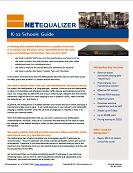
NetEqualizer Bandwidth Shaping Solution: K-12 Schools


Download K-12 Schools White Paper

In working with network administrators at public and private K-12 schools over the years, we’ve repeatedly heard the same issues and challenges facing them. Here are just a few:

  • We need a solution that’s low cost, low maintenance, and easy to set up.
  • We need a solution that will prioritize classroom videos and other online educational tools (e.g. blackboard.com).
  • We need to improve the overall Web-user experience for students.
  • We need a solution that doesn’t require “per-user” licensing.

In this article, we’ll talk about how the NetEqualizer has been used to solve these issues for many public and private K-12 schools around the world.

Download article (PDF) K-12 Schools White Paper

Read full article …

UPDATE — NetEqualizer Tech Seminar Is Coming To The Pacific Northwest


***UPDATE***

We have now confirmed the building and room number for the seminar. The location will be as follows:

Where: Pacific Lutheran University
Morken Center for Learning and Technology (MCLT), Room 103 (click here for map and directions)
12180 Park Ave.
Tacoma, WA

***UPDATE***

On Wednesday, January 13, we will be hosting a complimentary NetEqualizer Seminar at Pacific Lutheran University in Tacoma, Washington. PLU, which is the home of over 3,000 students, has been a NetEqualizer user since 2008 and will provide for a first-hand look at the technology’s capabilities.

We’ll cover:

  • The various tradeoffs regarding how to stem p2p and bandwidth abuse
  • Recommendations for curbing RIAA requests
  • Demo of the new NetEqualizer network access control module
  • Lots of customer Q&A and information sharing on how Pacific Lutheran University is using the NetEqualizer, including some hands-on probing of a live system

When: Wednesday, January 13, 10 a.m. to noon

Where: Pacific Lutheran University
Morken Center for Learning and Technology (MCLT), Room 103 (click here for map and directions)
12180 Park Ave.
Tacoma, WA

This technical user group, which in addition to our hosts includes invitees and NetEqualizer customers such as Everett Community College, the University of Puget Sound, and Northwest University, will be a great opportunity for current users and interested potential customers to learn more about the issues and challenges facing network administrators while also seeing the NetEqualizer in action.

Furthermore, the seminar will feature the input of Pacific Lutheran University students who will give first-hand accounts of the NetEqualizer end-user experience. For years, NetEqualizer has been a leader in network optimization technology that meets the needs of administrators, but also prioritizes the experience and privacy of Internet users.

If that wasn’t enough, we’ll be giving away great door prizes to attendees. So, if you’re in the area, be sure not to miss this seminar! For more information, contact us at admin@apconnections.net.

URL-Based Shaping With Your NetEqualizer: A How To Guide


What is URL-based Shaping?

URL shaping is the ability to specify the URL, normally a popular site such as YouTube or NetFlix, and set up a fixed-rate limit for traffic to that specific URL.

Is URL shaping just a matter of using a reverse lookup on a URL to get the IP address and plugging it into a bandwidth controller?

In the simplest case, yes, but for sites such as YouTube, the URL of http://www.youtube.com will have many associated IP addresses used for downloading actual videos. Shaping exclusively on the base URL would not be effective.

Is URL shaping the same thing as application shaping?

No. Although similar in some ways, there are significant differences:

  1. URL shaping is essentially the same as shaping by a known IP address. The trick with URL shaping is to discover IP addresses associated with a well-known URL.
  2. Application shaping uses Deep Packet Inspection (DPI). URL shaping does not. It does not inspect or open customer data.

How to set up URL-based shaping on your NetEqualizer

The following specifications are necessary:

  1. NetEqualizer version 4.0 or later
  2. A separate Linux-based client such that the client must access the Internet through the NetEqualizer
  3. The Perl source code for client URL shaping (listed below) loaded onto a client
  4. You will also need to set up your client so that it has permissions to run RSH (remote Shell) commands on your NetEqualizer without requiring a password to be entered. If you do not do this, your Perl discovery routine will hang. The notes for setting up the RSH permissions are outlined below.

How it works…

Save the Perl source code into a .pl file we suggest urlfinder.pl

Make sure to make this file executable

chmod 777 urlfinder.pl

Run the perl command with the following syntax from the command line, where domain.com will be replaced with the specific URL you wish to shape:

./urlfinder.pl http://www.domain.com pool# downlimit uplimit x.x.x.x y.y.y.y

  • Pool# is an unused bandwidth pool on your NetEqualizer unit
  • Downlimit is the rate in bytes per second incoming for the URL
  • Uplimit is the rate bytes per second outgoing to the Internet for the URL
  • x.x.x.x is the IP address of your NetEqualizer
  • y.y.y.y is the IP address of the client

The script will attempt an http request using http://www.domain.com. It will then continue to do recursive Web accesses on subsequent links starting on the main domain URL. It will stop when there are no more links to follow or when 150 pages have been accessed. Any foreign IP’s found during the access session will be put into the given bandwidth pool as CLASS B masks, and will immediately be forever shaped until you remove the pool.

Notes:

In our beta testing, the script did well in finding YouTube subnets used for videos.  We did not confirm whether the main NetFlix home page URL shares IP subnets with their download sites.

Notes for setting up RSH

Begin Notes

These notes  assume you are either logged in on the Client as root or you use sudo -i and are acting as root.

192.168.1.143 is used in the example as the Server (NetEq) IP.

On your Client machine, do:

  • ssh-keygen -t rsa -b 4096
  • ssh-copy-id -i ~/.ssh/id_rsa.pub root@192.168.1.143
  • nano -w /etc/ssh/ssh_config

Make sure that these are as follows:

  • RhostsRSAAuthentication yes
  • RSAAuthentication yes
  • EnableSSHKeysign yes
  • HostbasedAuthentication yes

The next line is all one line to the ssh_known_hosts

  • scp /etc/ssh/ssh_host_rsa_key.pub root@192.168.1.143:/etc/ssh/ssh_known_hosts

The next line is all one line to the ssh_known_hosts2

  • scp /etc/ssh/ssh_host_rsa_key.pub root@192.168.1.143:/etc/ssh/ssh_known_hosts2

Now, find out your HOSTNAME on the Client:

  • echo $HOSTNAME

On the Server machine, do:

  • nano -w /etc/hosts.equiv
  • harry-lin root
  • my $HOSTNAME of the Client was harry-lin
  • nano -w /etc/ssh/sshd_config

Check the following:

  • PermitRootLogin yes
  • StrictModes yes
  • RSAAuthentication yes
  • PubkeyAuthentication yes
  • AuthorizedKeysFile %h/.ssh/authorized_keys
  • IgnoreRhosts no
  • RhostsRSAAuthentication no
  • HostbasedAuthentication yes

Now do:

  • chown root:root /root

Then:

  • /etc/init.d/ssh reload

Now you can try something like this from your Client:

  • ssh root@192.168.1.143

If it doesn’t work, then do the following, which gives you details if possible:

  • ssh -v root@192.168.1.143

Final Notes: While support for this utility is NOT currently included with your NetEqualizer, we will assist any customers with a current Network Software Subscription for up to one hour. For additional support, consulting fees may apply.

Comcast Suit: Was Blocking P2P Worth the Final Cost?


By Art Reisman
CTO of APconnections
Makers of the plug-and-play bandwidth control and traffic shaping appliance NetEqualizer

Art Reisman CTO www.netequalizer.com

Comcast recently settled a class action suit in the state of Pennsylvania regarding its practice of selectively blocking of P2P.  So far, the first case was settled for 16 million dollars with more cases on the docket yet to come. To recap, Comcast and other large ISPs invested in technology to thwart P2P, denied involvment when first accused, got spanked by the FCC,  and now Comcast is looking to settle various class action suits.

When Comcast’s practices were established, P2P usage was sky-rocketing with no end in sight and the need to block some of it was required in order to preserve reasonable speeds for all users. Given that there was no specific law or ruling on the book, it seemed like mucking with P2P to alleviate gridlock was a rational business decision. This decision made even more sense considering that DSL providers were stealing disgruntled customers. With this said, Comcast wasn’t alone in the practice — all of the larger providers were doing it, throttling P2P to some extent to ensure good response times for all of their customers.

Yet, with the lawsuits mounting, it appears on face value that things backfired a bit for Comcast. Or did they?

We can work out some very rough estimates as the final cost trade-off. Here goes:

I am going to guess that before this plays out completely, settlements will run close to $50 million or more. To put that in perspective, Comcast shows a 2008 profit of close to $3 billion. Therefore, $50 million is hardly a dent to their stock holders. But, in order to play this out, we must ask what the ramifications would have been to not blocking P2P back when all of this began and P2P was a more serious bandwidth threat (Today, while P2P has declined, YouTube and online video are now the primary bandwidth hogs).

We’ll start with the customer. The cost of getting a new customer is usually calculated at around 6 months of service or approximately $300. So, to make things simple, we’ll assume the net cost of a losing a customer is roughly $300. In addition, there are also the support costs related to congested networks that can easily run $300 per customer incident.

The other more subtle cost of P2P is that the methods used to deter P2P traffic were designed to keep traffic on the Comcast network. You see, ISPs pay for exchanging data when they hand off to other networks, and by limiting the amount of data exchanged, they can save money. I did some cursory research on the costs involved with exchanging data and did not come up with anything concrete, so I’ll assume a P2P customer can cost you $5 per month.

So, lets put the numbers together to get an idea of how much potential financial damage P2P was causing back in 2007 (again, I must qualify that these are based on estimates and not fact. Comments and corrections are welcome).

  • Comcast had approximately 15 million broadband customers in 2008.
  • If 1 in 100 were heavy P2P users, the exchange cost would be $7.5 million per month in exchange costs.
  • Net lost customers to a competitor might be 1 in 500 a month. That would run $9 million a month.
  • Support calls due to preventable congestion might run another 1 out of 500 customers or $9 million a month.

So, very conservatively for 2007 and 2008, incremental costs related to unmitigated P2P could have easily run a total of $600 million right off the bottom line.

Therefore, while these calculations are approximations, in retrospect it was likely financially well worth the risk for Comcast to mitigate the effects of unchecked P2P. Of course, the public relations costs are much harder to quantify.

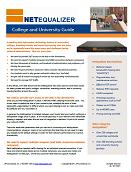
NetEqualizer Bandwidth Shaping Solution: Colleges, Universities, Boarding Schools, and University Housing


In working with information technology leaders at universities, colleges, boarding schools, and university housing over the years, we’ve repeatedly heard the same issues and challenges facing network administrators.  Here are just a few:

Download College & University White Paper

  • We need to provide 24/7 access to the web in the dormitories.
  • We need to support multiple campuses (and WAN connections between campuses).
  • We have thousands of students, and hundreds of administrators and professors, all sharing the same pipe.
  • We need to give priority to classroom videos used for educational purposes.
  • Our students want to play games and watch videos (e.g. YouTube).
  • We get calls if instant messaging & email are not responding instantaneously.
  • We need to manage P2P traffic.

In this article, we’ll talk about how the NetEqualizer has been used to solve these issues for many private and public colleges, universities, boarding schools, and in university housing facilities around the world.

Download article (PDF) College & University White Paper

Read full article …

Who’s Used Your NetEqualizer?


Over the past few years, we’ve made a game of putting together lists of celebrities, politicians, and other notable Internet users who may have experienced the benefits of the NetEqualizer via our customers’ networks (click here for more).

While we get our fair share of leads from casual conversations with NetEqualizer users, we’ve decided to make telling your story a little more enticing. So, we’re offering a limited number of $25 gift certificates to any operator willing to tell us of the notable Internet users that have experienced the NetEqualizer simply by being a guest on their network. Good rumors welcome! :)

NetEqualizer Tech Seminar Is Coming To The Pacific Northwest


On Wednesday, January 13, we will be hosting a complimentary NetEqualizer Seminar at Pacific Lutheran University in Tacoma, Washington. PLU, which is the home of over 3,000 students, has been a NetEqualizer user since 2008 and will provide for a first-hand look at the technology’s capabilities.

We’ll cover:

  • The various tradeoffs regarding how to stem p2p and bandwidth abuse
  • Recommendations for curbing RIAA requests
  • Demo of the new NetEqualizer network access control module
  • Lots of customer Q&A and information sharing on how Pacific Lutheran University is using the NetEqualizer, including some hands-on probing of a live system

When: Wednesday, January 13, 10 a.m. to noon

Where: Pacific Lutheran University
12180 Park Ave.
Tacoma, WA (specific on-campus location to come).

This technical user group, which in addition to our hosts includes invitees and NetEqualizer customers such as Everett Community College, the University of Puget Sound, and Northwest University, will be a great opportunity for current users and interested potential customers to learn more about the issues and challenges facing network administrators while also seeing the NetEqualizer in action.

Furthermore, the seminar will feature the input of Pacific Lutheran University students who will give first-hand accounts of the NetEqualizer end-user experience. For years, NetEqualizer has been a leader in network optimization technology that meets the needs of administrators, but also prioritizes the experience and privacy of Internet users.

If you’re in the area, be sure not to miss this seminar! For more information, contact us at admin@apconnections.net.

Welcome NetEqualizer Intern


Introduction from Art Reisman, CTO of APconnections
During a challenging economy, APconnections has remained committed to our customers and to our employees.  As part of this commitment, APconnections sponsors an internship program.  We believe that internships help talented, smart people get started in a new industry or technology area.  Please help us to welcome our new intern, Lynne, who will post to this blog periodically about her experiences at APconnections.

Thoughts from Lynne the intern:
I am starting an internship at APconnections, helping in the sales & marketing departments.  I’m really excited to get going on some of the projects that we have been thinking up, and mostly, to start interacting with you, our customers and prospects, to see what you are looking for from us.

My background is in IT, and I studied “management information systems” as part of my MBA, so I understand this product somewhat.  However, my career started in application development, and then moved to operations, and then back to application architecture.  So to say that I have focused on “applications” is an understatement!

Over my career in IT, I have also been a “generalist”, involved in projects as diverse as wireless, migrating O/S platforms and hardware servers, deploying websites, and rolling out ACH, as I enjoy learning all aspects of IT.  I have also project-managed, program-managed, and just overall managed stuff.   I have found in my “management” roles that I ended up being a de facto internal product manager for my software application.  I have become really interested in product management/marketing/sales and “product advocate” roles.  With the advent of social media, I’m really interested in taking this up a level for APconnections. 

This internship with APconnections gives me a chance to expand my experience in the IT product management/marketing/sales arena with a dynamic, growing, internet-based company.  I also think it is important to work with a product that I can believe in; it is obvious to me from the many repeat customers and “word-of-mouth” marketing that NetEqualizer has a recognized, compelling value proposition.

I hope to leverage my experience as a de facto product manager to help APconnections build a library of content.  My goal is to help encapsulate our expertise on networking, shaping, and all things related to bandwidth optimization into materials that help you, our customer.

As this is my first week, you can imagine that it has been learning all about “bandwidth shaping” and trying to figure out all the acronyms used in this space.  So far, I’ve picked up the following:  NIC, NAT, VLANs, VoIP, CF, and P2P.

I’ve read the entire FAQ (a good source if you want to see what questions people have on the NetEqualizer), the “Hitchhikers Guide to Network and WAN Optimization Technologies” White Paper (a fun read, I like that it is product agnostic), and of course reviewed the Online Demo (nice to see what the web front-end looks like – it is a real site!).  After all that, I still have some questions…  All that got me thinking…. if I was a management type trying to figure out what the NetEqualizer does (and I am), what would help me to better understand it?

My thoughts immediately turn to pictures, as I’m highly visual, and then of course to summaries, as who has time to review all the details!  On both those notes, here is what I’m thinking of putting together so far…

  1. 1 page picture(s) showing the Typical NetEqualizer Configuration
    (where to put it) by industry (if it differs)
  2. 1 page NetEqualizer Key Features & Functions Cheat Sheet
    Basically “what do I care about?”  in terms I understand (so-called management speak)
  3. Typical Network Traffic Flows, their sizes, and typical priorities
    To help management understand what VoIP, web pages, emails, video, real-time streaming video, and other typical types of traffic look like & behave like

And for you more technical types, I have thought of one thing so far…

  1. Cheat Sheet on the Default NetEqualizer Setup
    All the parameters that are set, all that are not, and what your options are to change these (and why). 

So that’s it for Week 1.  I will keep you updated on my progress throughout my internship.  I look forward to talking to some of you soon, to hear your thoughts!  In the meantime, if you have other ideas on what would help you (or me!) get up-to-speed on the NetEqualizer, networking, or the shaping world in general, email me at sales@apconnections.net.  Thanks!

What NetEqualizer Users Are Saying (Updated September 2010


Editor’s Note: As NetEqualizer’s popularity has grown, more and more users have been sharing their experiences on message boards and listservs across the Internet. Just to give you an idea of what they’re saying, here a few of the reviews and discussion excerpts that have been posted online over the past several months…

Tom Phelan, Peddie School
From 2nd week in Feb, 2010 ISED-L listserv archive

For QoS we used several different traditional QoS solutions over the years. We have Websense, but we don’t use it to manage QoS issues, just access to certain sites. After years of constantly tweaking QoS rules and never being completely satisfied with the results we decided to go a completely different direction and bought NetEqualizer (http://www.netequalizer.com/) in Sept 2008 I think. Once we set it up we haven’t touched it and we’ll never go back. We haven’t tweaked a rule in well over a year. You can read about how it works on their website, but in a nutshell it takes a completely different approach to QoS. Rather than using a complex set of rules, it takes a protocol and URL agnostic approach to QoS and focuses exclusively on bandwidth usage.

Basically, it works by slowing down only the top bandwidth users once usage hits a defined percentage of overall bandwidth. For example, when our bandwidth usage is less than 85% the NetEqualizer does nothing. When it goes over 85% the NE puts a slight delay on packets from top users and progressively adds a delay to their packets to ensure bandwidth stays below the defined connection max. The effect is that the vast majority of users see no degradation of service and bandwidth hogs have their connections slowed. It takes into account bursty traffic like HTTP by calculating bandwidth based on several seconds of traffic so web browsing is rarely affected. There are some rules to allow exceptions for servers or special devices, facilitate low bandwidth streaming, put caps on certain IP addresses, etc., but we have found that a minimalist approach to configuration works best.

In addition to providing a better experience for our users, we’ve also seen our average bandwidth usage go way up because during off peak times nobody is getting slowed. We pay for the bandwidth, why not use it? I highly recommend it and its simplicity makes it relatively cheap. It is a fraction of the cost of many other QoS solutions.

I recommend using the NetEqualizer for QoS and let ISA stick to what it does best which is to control access not manage QoS.

__________________________________________________________________________________________________

Dave Barker, Broadlinc Communications

I just wanted to let you guys at Netequalizer know how much I depend on my NE2000. I am a small ISP with about 360 customers and I would be lost without the Netequalizer. The people there are always very friendly and quick to respond. Keep up the great work.

__________________________________________________________________________________________________

Kevin Kershner, CS&T Inc.

I admin several NetEqualizers in hospital and county couthouse networks and the clients love them.  They let employees have freedom from whitelists and yet keep data lines open for legit traffic, makes for happier employees.

__________________________________________________________________________________________________

Damien McNabb, Ronaldcom.ca

We provide IT support and services for a large hotel and conference center here in Russell Manitoba. Since installing the NetEqualizer our Internet Congestion  during peak usage has disappeared. I was so impressed with the NetEqualizer that we are now  installing two more NetEqualizer units at  other  smaller resort properties here in town.

__________________________________________________________________________________________________

Craig Mackay, Director, Mascon Cable Systems, AirSpeed Wireless Inc

We just returned from the cable operators convention here in Canada. We were surprised to learn that similar operators without the benefit on a NetEqualizer often needed as much as 250 megabits sustained bandwidth to keep 650 users running. We on the other hand run about 4000 on 60 megabits made possible by the unique abilities of our NetEqualizer to distribute out the load over time more efficiently. That translates to the NetEqualizer investment paying for itself many times over…

__________________________________________________________________________________________________

Mike Ferguson, Chapman University

I’d also recommend you look at the NetEqualizer. We evaluated it this summer along with several other packet-shaping solutions. We also needed to upgrade our NetEnforcer to handle more than 100M for our ResHalls, but we weren’t impressed with its P2P classification. As a matter of fact, we haven’t had much success using L7 packet inspection of P2P traffic with other solutions: either using our Fortigate firewalls, the Packeteer box we used before, or the NetEnforcer we just retired. We don’t block P2P, but we do want to throttle it. You can be diligent about updating your policies from the manufacturer as soon as they’re released; however, we found a significant amout of P2P traffic still bypassed the filters right after an update because it wasn’t identified properly.

Our work-around with the NetEnforcer was to throttle the number of connections per second and limit the total amount of bandwidth per IP. But we always felt we were constraining our available resources, particularly by reducing bandwidth per IP, as we were limiting a person’s bandwidth to DSL/Cable-like levels just because of lack of L7 capabilities.

With the NetEqualizer, we’re still limiting the number of connections per second, but we’re using the “behavior” algorithms to dynamically adjust bandwidth per IP so all users are given a fair amount of bandwidth. But at the same time, we’re still able to throttle P2P traffic just as effectively without it affecting quality video streaming or anything else non-P2P related.

Last, the cost is 1/4th to 1/7th less than a comparable L7 solution. We were able to buy 2 NetEqualizer units and hook them to both our public core boxes for redundancy. The total price was astoundling less than any other solution we looked at, except one which didn’t meet our requirements. For the other solutions, the price you’re paying is to invest in their R&D efforts to classify L7 traffic accurately and manage it effectively. But our experience using the NetEqualizer for the last 2 months has been that it manages bandwidth just as well, if not better.

In our case, we have just less than 2000 residents, but we also have wireless clients on the Academic side that go through the same NetEqualizer (NE3000). Our second unit is strictly for failover. I’ve seen up to 4500 active users, which at night we give 150M of bandwidth. Even at peak (100%) utilization of the allotted bandwidth, the NetEqualizer gives great results.

————————————————————————————————————————————————————-

Daniel. K. Biodun
VPN / Support
Network Operation Center Dept (NOC)
Coollink Nigeria’s ICT powerhouse.

We use NetEqualizer to manage our growing broadband network across Nigeria. It definitely gave us a return on investment right away.

__________________________________________________________________________________________________

To see what more customers are saying, click here.

Bandwidth Quota Prophecy plays out at Comcast.


A couple of years ago we pointed out how implementing a metered usage policy could create additional overhead.  Here is an excerpt:

To date, it has not been a good idea to flaunt a quota policy and many ISPs do their best to keep it under the radar. In addition, enforcing and demonstrating a quota-based system to customers will add overhead costs and also create more customer calls and complaints. It will require more sophistication in billing and the ability for customers to view their accounts in real time. Some consumers will demand this, and rightly so.

Today two years after Comcast started a fair use policy based on Quota’s they announced a new tool for customers that allows customers to see their usage and  gives them a warning before being cut off.  I suspect the new tool is designed to alleviate the issues we mention in our paragraph above.

NetEqualizer customers can usually accomplish bandwidth reductions fairly without the complexity of quota systems , but in a pinch we also have a quota system on our equipment.

Need for Equalizing on Verizon Data Network ?


By Art Reisman

CTO http://www.netequalizer.com

I read a blog post today describing how the 3g wireless providers will not have proper capacity to meet growing demand. Data usage with the  boom of personal devices has finally ramped up and caught them underpowered.

My observations:

It just  so happens that I rely on a Verizon broadband card when I am on the road. I love their service it is by far the best of other carriers I have tried.

I spent a couple days in Gainesville Florida this week , and where my Verizon connection seemed consistently closer to  dial up when anecdotally compared to  typical broad band.  My measurement technique  is pragmatic, and less than scientific, if  I wait for 4 to 5 seconds for a small text e-mail to send, it is sure sign I am not on their 3g network. You can move in and out of 3g service depending on where you are. I then went down to Sanibel Island and my speeds picked back up to broad band levels again.

The Sanibel speeds put an exclamation on how degraded my service was up in Gainesville.  Obviously this anectdotal as there could be other factors at play here , but here are the  two obvious explanations for the increased response times on Sanibel Island when compared to Gainesville.

1) Gainesville is not covered by 3g (high speed broadband)

2) Sanibel island lacks the College students and younger crowd that pressure data usage with their downloads of videos and streaming audio.

I am guessing the answer is number 2.

ALthough verizon , in my opinion cleary has the best network, there is some room for improvement here in Florida.

Based on my limited obervations this week, I suspect that  a few strategically placed  Netequalizers would help speed up response times for services such as e-mail and web browsing in these congested areas.  Obviously this would be at the expense of people watching videos on their portable devices; however it is unlikely those services are running all the quickly on congested network to start with.

How does your ISP actually enforce your Internet Speed


By Art Reisman, CTO, www.netequalizer.com


Art Reisman CTO www.netequalizer.com

YT

Have you ever wondered how your ISP manages to control the speed of your connection? If so, you might find the following article enlightening.  Below, we’ll discuss the various trade-offs used to control and break out bandwidth rate limits and the associated side effects of using those techniques.

Dropping Packets (Cisco term “traffic policing”)

One of the simplest methods for a bandwidth controller to enforce a rate cap is by dropping packets. When using the packet-dropping method, the bandwidth controlling device will count the total number of bytes that cross a link during a second.  If the target rate is exceeded during any single second, the bandwidth controller will drop packets for the remainder of that second. For example, if the bandwidth limit is 1 megabit, and the bandwidth controller counts 1 million bits gone by  in 1/2 a second, it will then drop packets for the remainder of the second.  The counter will then reset for the next second. From most evidence we have observed, rate caps enforced by many ISPs use the drop packet method, as it is the least expensive method supported on most basic routers.

So, what is wrong with dropping packets to enforce a bandwidth cap?

Well, when a link hits a rate cap and packets are dropped en masse, it can wreak havoc on a network. For example, the standard reaction of a Web browser when it perceives web traffic is getting lost is to re-transmit the lost data. For a better understanding of dropping packets, let’s use the analogy of a McDonald’s fast food restaurant.

Suppose the manager of the restaurant was told his bonus was based on making sure there was a never a line at the cash register. So, whenever somebody showed up to order food when all registers were occupied, the manager would open a trap door conveniently ejecting   the customer back out into the parking lot.  The customer, being extremely hungry, will come running back in the door (unless of course they die of starvation or get hit by a car) only to be ejected again. To make matters worse, let’s suppose a bus load of school kids arrive. As the kids file in to the McDonald’s, the remaining ones on the bus have no idea their classmates inside are getting ejected, so they keep streaming into the McDonald’s. Hopefully, you get the idea.

Well, when bandwidth shapers deploy packet-dropping technology to enforce a rate cap, you can get the same result seen with the trapdoor analogy in the McDonald’s. Web browsers and other user-based applications will beat their heads into the wall when they don’t get responses from their counterparts on the other end of the line. When packets are being dropped en masse,  the network tends to spiral out-of-control until all the applications essentially give up.  Perhaps you have seen this behavior while staying at a hotel with an underpowered Internet link. Your connectivity will alternate between working and then hanging up completely for a minute or so during busy hours. This can obviously be very maddening.

The solution to shaping bandwidth on a network without causing gridlock is to implement queuing.

Queuing Packets (Cisco term “traffic shaping”)

Queuing is the art of putting something in a line and making it wait before continuing on. Obviously, this is what fast food restaurants do in reality. They plan enough staff on hand to handle the average traffic throughout the day, and then queue up their customers when they are arriving at a faster rate then they can fill orders. The assumption with this model is that at some point during the day the McDonald’s will get caught up with the number of arriving customers and the lines will shrink away.

Another benefit of queuing is that wait times can perhaps be estimated by customers as they drive by and see the long line extending out into the parking lot, and thus, they will save their energy and not attempt to go inside.

But, what happens in the world of the Internet?

With queuing methods implemented, a bandwidth controller looks at the data rate of the incoming packets, and if deemed too fast, it will delay the packets in a queue. The packets will eventually get to their destination, albeit somewhat later than expected. Packets on queue can pile up very quickly, and without some help, the link would saturate. Computer memory to store the packets in the queue would also saturate and, much like the scenario mentioned above, the packets would eventually get dropped if they continued to come in at a faster rate than they were sent out.

TCP to the Rescue (keeping queuing under control)

Most internet applications use a service called TCP (transmission control protocol) to handle their data transfers. TCP has developed intelligence to figure out the speed of the link for which it is sending data on, and then can make adjustments. When the NetEqualizer bandwidth controller queues a packet or two, the TCP controllers on the customer end-point computers will sense the slower packets and back off the speed of the transfer. With just a little bit of queuing, the sender slows down a bit and dropping packets can be kept to a minimum.

Queuing Inside the NetEqualizer

The NetEqualizer bandwidth shaper uses a combination of queuing and dropping packets to get speed under control. Queuing is the first option, but when a sender does not back off eventually, their packets will get dropped. For the most part, this combination of queuing and dropping works well.

So far we have been inferring a simple case of a single sender and a single queue, but what happens if you have gigabit link with 10,000 users and you want to break off 100 megabits to be shared by 3000 users? How would a bandwidth shaper accomplish this? This is another area where a well-designed bandwidth controller like the NetEqualizer separates itself from the crowd.

In order to provide smooth shaping for a large group of users sharing a link, the NetEqualizer does several things in combination.

  1. It keeps track of all streams, and based on their individual speeds, the NetEqualizer will use different queue delays on each stream.
  2. Streams that back off will get minimal queuing
  3. Streams that do not back off may eventually have some of their packets dropped

The net effect of the NetEqualizer queuing intelligence is that all users will experience steady response times and smooth service.

Notes About UDP and Rate Limits

Some applications such as video do not use TCP to send data. Instead, they use a “send-and-forget” mechanism called UDP, which has no built-in back-off mechanism. Without some higher intelligence, UDP packets will continue to be sent at a fixed rate, even if the packets are coming too quickly for the receiver.  The good news is that even most UDP applications also have some way of measuring if their packets are getting to their destination. It’s just that with UDP, the mechanism of synchronization is not standardized.

Finally there are those applications that just don’t care if the packets get to their destination. Speed tests and viruses send UDP packets as fast as they can, regardless of whether the network can handle them or not. The only way to enforce a rate cap with such ill-mannered application is to drop the packets.

Hopefully this primer has given you a good introduction to the mechanisms used to enforce Internet Speeds, namely dropping packets & queuing.  And maybe you will think about this the next time you visit a fast food restaurant during their busy time…

APconnections’ NetEqualizer Reaches Three Million Users and Growing


LAFAYETTE, Colo., November 16, 2009 — APconnections, a leading supplier of plug-and-play bandwidth shaping products, today announced that over three million Internet users have been served by companies implementing its NetEqualizer technology.

The NetEqualizer is a plug-and-play bandwidth control and WAN/Internet optimization appliance that is flexible and scalable. When the network is congested, NetEqualizer’s unique “behavior shaping” technology gives priority to latency sensitive applications, such as VoIP and email. It does it all dynamically and automatically, improving on other bandwidth shaping technology out there. It controls network flow for the best WAN optimization.

Since being introduced in 2003, the NetEqualizer has been successfully installed in businesses, libraries, universities, ISPs, and office parks around the world. Administrators have found the technology to be extremely effective in networks both large and small.

“We switched to a NetEqualizer in 2006 after previously using a high-end solution and have been very pleased with the results ever since. It’s been exactly what we were looking for and has worked just as advertised,” said Derrick D’Gama, director of Information Services at Lewis University. “We provide Internet service to over 5,000 students and have now effectively minimized any bandwidth issues. To have such a low-maintenance product work so well has made my job that much easier.”

In order to match its proven track record, the NetEqualizer is constantly evolving to meet the developing demands of the technology industry. Over the past two months, NetEqualizer has released software capable of name-based shaping and shaping over VLAN. The NetEqualizer is also now able to serve as a CALEA probe, offering ISPs an affordable, yet effective, answer to recently introduced law enforcement regulations.

To better demonstrate the NetEqualizer’s capabilities, APconnecitons is now offering a free online live demo of the technology at its Web site, http://www.netequalizer.com.

APconnections is a privately held company founded in 2003 and is based in Lafayette, Colorado.