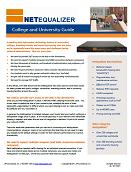
NetEqualizer Bandwidth Shaping Solution: Colleges, Universities, Boarding Schools, and University Housing


In working with information technology leaders at universities, colleges, boarding schools, and university housing over the years, we’ve repeatedly heard the same issues and challenges facing network administrators.  Here are just a few:

Download College & University White Paper

  • We need to provide 24/7 access to the web in the dormitories.
  • We need to support multiple campuses (and WAN connections between campuses).
  • We have thousands of students, and hundreds of administrators and professors, all sharing the same pipe.
  • We need to give priority to classroom videos used for educational purposes.
  • Our students want to play games and watch videos (e.g. YouTube).
  • We get calls if instant messaging & email are not responding instantaneously.
  • We need to manage P2P traffic.

In this article, we’ll talk about how the NetEqualizer has been used to solve these issues for many private and public colleges, universities, boarding schools, and in university housing facilities around the world.

Download article (PDF) College & University White Paper

Read full article …

Who’s Used Your NetEqualizer?


Over the past few years, we’ve made a game of putting together lists of celebrities, politicians, and other notable Internet users who may have experienced the benefits of the NetEqualizer via our customers’ networks (click here for more).

While we get our fair share of leads from casual conversations with NetEqualizer users, we’ve decided to make telling your story a little more enticing. So, we’re offering a limited number of $25 gift certificates to any operator willing to tell us of the notable Internet users that have experienced the NetEqualizer simply by being a guest on their network. Good rumors welcome! :)

Welcome NetEqualizer Intern


Introduction from Art Reisman, CTO of APconnections
During a challenging economy, APconnections has remained committed to our customers and to our employees.  As part of this commitment, APconnections sponsors an internship program.  We believe that internships help talented, smart people get started in a new industry or technology area.  Please help us to welcome our new intern, Lynne, who will post to this blog periodically about her experiences at APconnections.

Thoughts from Lynne the intern:
I am starting an internship at APconnections, helping in the sales & marketing departments.  I’m really excited to get going on some of the projects that we have been thinking up, and mostly, to start interacting with you, our customers and prospects, to see what you are looking for from us.

My background is in IT, and I studied “management information systems” as part of my MBA, so I understand this product somewhat.  However, my career started in application development, and then moved to operations, and then back to application architecture.  So to say that I have focused on “applications” is an understatement!

Over my career in IT, I have also been a “generalist”, involved in projects as diverse as wireless, migrating O/S platforms and hardware servers, deploying websites, and rolling out ACH, as I enjoy learning all aspects of IT.  I have also project-managed, program-managed, and just overall managed stuff.   I have found in my “management” roles that I ended up being a de facto internal product manager for my software application.  I have become really interested in product management/marketing/sales and “product advocate” roles.  With the advent of social media, I’m really interested in taking this up a level for APconnections. 

This internship with APconnections gives me a chance to expand my experience in the IT product management/marketing/sales arena with a dynamic, growing, internet-based company.  I also think it is important to work with a product that I can believe in; it is obvious to me from the many repeat customers and “word-of-mouth” marketing that NetEqualizer has a recognized, compelling value proposition.

I hope to leverage my experience as a de facto product manager to help APconnections build a library of content.  My goal is to help encapsulate our expertise on networking, shaping, and all things related to bandwidth optimization into materials that help you, our customer.

As this is my first week, you can imagine that it has been learning all about “bandwidth shaping” and trying to figure out all the acronyms used in this space.  So far, I’ve picked up the following:  NIC, NAT, VLANs, VoIP, CF, and P2P.

I’ve read the entire FAQ (a good source if you want to see what questions people have on the NetEqualizer), the “Hitchhikers Guide to Network and WAN Optimization Technologies” White Paper (a fun read, I like that it is product agnostic), and of course reviewed the Online Demo (nice to see what the web front-end looks like – it is a real site!).  After all that, I still have some questions…  All that got me thinking…. if I was a management type trying to figure out what the NetEqualizer does (and I am), what would help me to better understand it?

My thoughts immediately turn to pictures, as I’m highly visual, and then of course to summaries, as who has time to review all the details!  On both those notes, here is what I’m thinking of putting together so far…

  1. 1 page picture(s) showing the Typical NetEqualizer Configuration
    (where to put it) by industry (if it differs)
  2. 1 page NetEqualizer Key Features & Functions Cheat Sheet
    Basically “what do I care about?”  in terms I understand (so-called management speak)
  3. Typical Network Traffic Flows, their sizes, and typical priorities
    To help management understand what VoIP, web pages, emails, video, real-time streaming video, and other typical types of traffic look like & behave like

And for you more technical types, I have thought of one thing so far…

  1. Cheat Sheet on the Default NetEqualizer Setup
    All the parameters that are set, all that are not, and what your options are to change these (and why). 

So that’s it for Week 1.  I will keep you updated on my progress throughout my internship.  I look forward to talking to some of you soon, to hear your thoughts!  In the meantime, if you have other ideas on what would help you (or me!) get up-to-speed on the NetEqualizer, networking, or the shaping world in general, email me at sales@apconnections.net.  Thanks!

What NetEqualizer Users Are Saying (Updated September 2010


Editor’s Note: As NetEqualizer’s popularity has grown, more and more users have been sharing their experiences on message boards and listservs across the Internet. Just to give you an idea of what they’re saying, here a few of the reviews and discussion excerpts that have been posted online over the past several months…

Tom Phelan, Peddie School
From 2nd week in Feb, 2010 ISED-L listserv archive

For QoS we used several different traditional QoS solutions over the years. We have Websense, but we don’t use it to manage QoS issues, just access to certain sites. After years of constantly tweaking QoS rules and never being completely satisfied with the results we decided to go a completely different direction and bought NetEqualizer (http://www.netequalizer.com/) in Sept 2008 I think. Once we set it up we haven’t touched it and we’ll never go back. We haven’t tweaked a rule in well over a year. You can read about how it works on their website, but in a nutshell it takes a completely different approach to QoS. Rather than using a complex set of rules, it takes a protocol and URL agnostic approach to QoS and focuses exclusively on bandwidth usage.

Basically, it works by slowing down only the top bandwidth users once usage hits a defined percentage of overall bandwidth. For example, when our bandwidth usage is less than 85% the NetEqualizer does nothing. When it goes over 85% the NE puts a slight delay on packets from top users and progressively adds a delay to their packets to ensure bandwidth stays below the defined connection max. The effect is that the vast majority of users see no degradation of service and bandwidth hogs have their connections slowed. It takes into account bursty traffic like HTTP by calculating bandwidth based on several seconds of traffic so web browsing is rarely affected. There are some rules to allow exceptions for servers or special devices, facilitate low bandwidth streaming, put caps on certain IP addresses, etc., but we have found that a minimalist approach to configuration works best.

In addition to providing a better experience for our users, we’ve also seen our average bandwidth usage go way up because during off peak times nobody is getting slowed. We pay for the bandwidth, why not use it? I highly recommend it and its simplicity makes it relatively cheap. It is a fraction of the cost of many other QoS solutions.

I recommend using the NetEqualizer for QoS and let ISA stick to what it does best which is to control access not manage QoS.

__________________________________________________________________________________________________

Dave Barker, Broadlinc Communications

I just wanted to let you guys at Netequalizer know how much I depend on my NE2000. I am a small ISP with about 360 customers and I would be lost without the Netequalizer. The people there are always very friendly and quick to respond. Keep up the great work.

__________________________________________________________________________________________________

Kevin Kershner, CS&T Inc.

I admin several NetEqualizers in hospital and county couthouse networks and the clients love them.  They let employees have freedom from whitelists and yet keep data lines open for legit traffic, makes for happier employees.

__________________________________________________________________________________________________

Damien McNabb, Ronaldcom.ca

We provide IT support and services for a large hotel and conference center here in Russell Manitoba. Since installing the NetEqualizer our Internet Congestion  during peak usage has disappeared. I was so impressed with the NetEqualizer that we are now  installing two more NetEqualizer units at  other  smaller resort properties here in town.

__________________________________________________________________________________________________

Craig Mackay, Director, Mascon Cable Systems, AirSpeed Wireless Inc

We just returned from the cable operators convention here in Canada. We were surprised to learn that similar operators without the benefit on a NetEqualizer often needed as much as 250 megabits sustained bandwidth to keep 650 users running. We on the other hand run about 4000 on 60 megabits made possible by the unique abilities of our NetEqualizer to distribute out the load over time more efficiently. That translates to the NetEqualizer investment paying for itself many times over…

__________________________________________________________________________________________________

Mike Ferguson, Chapman University

I’d also recommend you look at the NetEqualizer. We evaluated it this summer along with several other packet-shaping solutions. We also needed to upgrade our NetEnforcer to handle more than 100M for our ResHalls, but we weren’t impressed with its P2P classification. As a matter of fact, we haven’t had much success using L7 packet inspection of P2P traffic with other solutions: either using our Fortigate firewalls, the Packeteer box we used before, or the NetEnforcer we just retired. We don’t block P2P, but we do want to throttle it. You can be diligent about updating your policies from the manufacturer as soon as they’re released; however, we found a significant amout of P2P traffic still bypassed the filters right after an update because it wasn’t identified properly.

Our work-around with the NetEnforcer was to throttle the number of connections per second and limit the total amount of bandwidth per IP. But we always felt we were constraining our available resources, particularly by reducing bandwidth per IP, as we were limiting a person’s bandwidth to DSL/Cable-like levels just because of lack of L7 capabilities.

With the NetEqualizer, we’re still limiting the number of connections per second, but we’re using the “behavior” algorithms to dynamically adjust bandwidth per IP so all users are given a fair amount of bandwidth. But at the same time, we’re still able to throttle P2P traffic just as effectively without it affecting quality video streaming or anything else non-P2P related.

Last, the cost is 1/4th to 1/7th less than a comparable L7 solution. We were able to buy 2 NetEqualizer units and hook them to both our public core boxes for redundancy. The total price was astoundling less than any other solution we looked at, except one which didn’t meet our requirements. For the other solutions, the price you’re paying is to invest in their R&D efforts to classify L7 traffic accurately and manage it effectively. But our experience using the NetEqualizer for the last 2 months has been that it manages bandwidth just as well, if not better.

In our case, we have just less than 2000 residents, but we also have wireless clients on the Academic side that go through the same NetEqualizer (NE3000). Our second unit is strictly for failover. I’ve seen up to 4500 active users, which at night we give 150M of bandwidth. Even at peak (100%) utilization of the allotted bandwidth, the NetEqualizer gives great results.

————————————————————————————————————————————————————-

Daniel. K. Biodun
VPN / Support
Network Operation Center Dept (NOC)
Coollink Nigeria’s ICT powerhouse.

We use NetEqualizer to manage our growing broadband network across Nigeria. It definitely gave us a return on investment right away.

__________________________________________________________________________________________________

To see what more customers are saying, click here.

Bandwidth Quota Prophecy plays out at Comcast.


A couple of years ago we pointed out how implementing a metered usage policy could create additional overhead.  Here is an excerpt:

To date, it has not been a good idea to flaunt a quota policy and many ISPs do their best to keep it under the radar. In addition, enforcing and demonstrating a quota-based system to customers will add overhead costs and also create more customer calls and complaints. It will require more sophistication in billing and the ability for customers to view their accounts in real time. Some consumers will demand this, and rightly so.

Today two years after Comcast started a fair use policy based on Quota’s they announced a new tool for customers that allows customers to see their usage and  gives them a warning before being cut off.  I suspect the new tool is designed to alleviate the issues we mention in our paragraph above.

NetEqualizer customers can usually accomplish bandwidth reductions fairly without the complexity of quota systems , but in a pinch we also have a quota system on our equipment.

Need for Equalizing on Verizon Data Network ?


By Art Reisman

CTO http://www.netequalizer.com

I read a blog post today describing how the 3g wireless providers will not have proper capacity to meet growing demand. Data usage with the  boom of personal devices has finally ramped up and caught them underpowered.

My observations:

It just  so happens that I rely on a Verizon broadband card when I am on the road. I love their service it is by far the best of other carriers I have tried.

I spent a couple days in Gainesville Florida this week , and where my Verizon connection seemed consistently closer to  dial up when anecdotally compared to  typical broad band.  My measurement technique  is pragmatic, and less than scientific, if  I wait for 4 to 5 seconds for a small text e-mail to send, it is sure sign I am not on their 3g network. You can move in and out of 3g service depending on where you are. I then went down to Sanibel Island and my speeds picked back up to broad band levels again.

The Sanibel speeds put an exclamation on how degraded my service was up in Gainesville.  Obviously this anectdotal as there could be other factors at play here , but here are the  two obvious explanations for the increased response times on Sanibel Island when compared to Gainesville.

1) Gainesville is not covered by 3g (high speed broadband)

2) Sanibel island lacks the College students and younger crowd that pressure data usage with their downloads of videos and streaming audio.

I am guessing the answer is number 2.

ALthough verizon , in my opinion cleary has the best network, there is some room for improvement here in Florida.

Based on my limited obervations this week, I suspect that  a few strategically placed  Netequalizers would help speed up response times for services such as e-mail and web browsing in these congested areas.  Obviously this would be at the expense of people watching videos on their portable devices; however it is unlikely those services are running all the quickly on congested network to start with.

APconnections’ NetEqualizer Reaches Three Million Users and Growing


LAFAYETTE, Colo., November 16, 2009 — APconnections, a leading supplier of plug-and-play bandwidth shaping products, today announced that over three million Internet users have been served by companies implementing its NetEqualizer technology.

The NetEqualizer is a plug-and-play bandwidth control and WAN/Internet optimization appliance that is flexible and scalable. When the network is congested, NetEqualizer’s unique “behavior shaping” technology gives priority to latency sensitive applications, such as VoIP and email. It does it all dynamically and automatically, improving on other bandwidth shaping technology out there. It controls network flow for the best WAN optimization.

Since being introduced in 2003, the NetEqualizer has been successfully installed in businesses, libraries, universities, ISPs, and office parks around the world. Administrators have found the technology to be extremely effective in networks both large and small.

“We switched to a NetEqualizer in 2006 after previously using a high-end solution and have been very pleased with the results ever since. It’s been exactly what we were looking for and has worked just as advertised,” said Derrick D’Gama, director of Information Services at Lewis University. “We provide Internet service to over 5,000 students and have now effectively minimized any bandwidth issues. To have such a low-maintenance product work so well has made my job that much easier.”

In order to match its proven track record, the NetEqualizer is constantly evolving to meet the developing demands of the technology industry. Over the past two months, NetEqualizer has released software capable of name-based shaping and shaping over VLAN. The NetEqualizer is also now able to serve as a CALEA probe, offering ISPs an affordable, yet effective, answer to recently introduced law enforcement regulations.

To better demonstrate the NetEqualizer’s capabilities, APconnecitons is now offering a free online live demo of the technology at its Web site, http://www.netequalizer.com.

APconnections is a privately held company founded in 2003 and is based in Lafayette, Colorado.

How Does NetEqualizer compare to Mikrotik


Mikrotik is a super charged Swiss army knife solution, no feature is off limits on their product, routing , bandwidth control, layer seven filters, PPPoe, firewall they have it all. If I was going off to start a WISP with a limited budget, and could bring only one tool with me, it would be a Mikrotik solution. On the other hand the NetEqualizer grew up with the value equation of optimizing bandwidth on a network and doing it in a smart turn key fashion. It was developed by a wireless operator that realized high quality easy to use bandwidth control  was needed to ensure a profitable business.

Yes there is some overlap between the two,  over time the NetEqualizer has gone beyond their included auxillary features,  for example:  NetEqualizer has a firewall and  a network access control module; but the primary reason an operator would purchase a NetEqualizer still goes back to our core mission.  To keep their margins in this competitive business, they need to optimize their Internet trunk without paying an army of technicians to maintain a piece of equipment.


The following was part of a conversation with a customer who was interested in comparing Mikrotik queues to NetEqualizer Equalizinq. So take off your Mikrotik hat for a minute and read on about a different philosophy on how to control bandwidth.

Equalizing is a bit different than  Microtik, so we can’t make exact
feature comparisons.  NetEqualizer lets users run until the network
(or pool) is crowded and then slaps the heavy users for a very short
duration, faster than you  or I could do it  (if you tried). Do you
have the arcade game “wack a mole”  in Australia?  Where you hit the
moles on the head when they pop up out of the holes with a hammer?

The vision of our product was to allow operators to plug it in ,give
priority to short real time traffic when the network is busy, and to
leave it alone when shaping is not needed.

It does this based on connections not based on users (as per your question)

Suppose out of your 1000 users, 90 percent were web surfing , 5
percent watching youtube, and  20 percent were doing chat sessions
while doing youtube and web surfing, and another 20 percent were on
SKype calls while web surfing.

Based on the different demand levels of all these users it is nearly
impossible to divide the bandwidth evenly.

But, If the trunk was saturated, in the example above, the
NetEqualizer would chop down youtube streams (since they are the
biggest) leaving all the other streams alone. So instead of having
your network crash completely a few youtube videos would break up for
a few seconds and then when conditions abated they would be allowed to
run. I cannot tell you the exact allocations per user because we don’t
try to hit fixed allocations, we just put delay on the nasties until
the bandwidth usage overall drops back to 90 percent.  It is never the
same . And then we quickly take the delay away when things are better.

The value to you is that you get the best possible usage of your
network bandwidth without micro managing everything. There are no
queues to manage. We have been using this model with ISPs for 6 years.

If you do want to put additional rules onto users you can do that with
individual rate limits. Or VLAN limits.

Lastly if you have a very high priority client that must run video you
can give them an exemption if needed.

To control p2p you can use our connection limits as most p2p clients
overload APs with massive connections. We have a fairly smart simple
way to spot this type of user and keep them from crashing your network.
Created by APconnections, the NetEqualizer is a plug-and-play bandwidth control and WAN/Internet optimization appliance that is flexible and scalable. When the network is congested, NetEqualizer’s unique “behavior shaping” technology dynamically and automatically gives priority to latency sensitive applications, such as VoIP and email. Click here for a full price list. .

NetEqualizer provides Net Neutrality solution for bandwidth control.


By Eli Riles NetEqualizer VP of Sales

This morning I read an article on how some start up companies are being hurt awaiting the FCC’s decision on Net Neutrality.

Late in the day, a customer called and exclaimed, “Wow now with the FCC coming down  hard on technologies that jeopardize net neutrality, your business  must booming since you offer an excellent viable alternative” And yet  in face of this controversy, several of our competitors continue to sell deep packet inspection devices to customers.

Public operators and businesses that continue to purchase such technology are likely uninformed about the growing fire-storm of opposition against Deep Packet Inspection techniques.  The allure of being able to identify, and control Internet Traffic by type is very a natural solution, which customers often demand. Suppliers who sell DPI devices are just doing what their customer have asked. As with all technologies once the train leaves the station it is hard to turn around. What is different in the case of DPI is that suppliers and ISPs had their way with an ignorant public starting in the late 90’s. Nobody really gave much thought as to how DPI might be the villain in the controversy over Net Nuetrality. It was just assumed that nobody would notice their internet traffic being watched and redirected by routing devices. With behemoths such as Google having a vested interest in keeping traffic flowing without Interference on the Internet, commercial deep packet inspection solutions are slowly falling out of favor in the ISP sector. The bigger question for the players betting the house on DPI is , will it fall out favor in other  business verticals?

The NetEqualizer decision to do away with DPI two years ago is looking quite brilliant now, although at the time it was clearly a risk bucking market trends.  Today, even in the face of world wide recession our profit and unit sales are up for the first three quarters of 2009 this year.

As we have claimed in previous articles there is a time and place for deep packet inspection; however any provider using DPI to manipulate data is looking for a potential dog fight with the FCC.

NetEqualizer has been providing alternative bandwidth control options for ISPs , Businesses , and Schools of all sizes for 7 years without violating any of the Net Nuetrality sacred cows. If you have not heard about us, maybe now is a good time to pick up the phone. We have been on the record touting our solution as being fair equitable for quite some time now.

Using NetEqualizer Lite to prevent the 802.11 Hidden Terminal problem


Introduction

Of the numerous growing pains that can accompany the expansion of a wireless network, the hidden terminal problems is one of the most difficult problems to solve. Despite your best efforts, the communication breakdown between nodes can wreak havoc on a network, often leading to sub par performance and unhappy users.

What is a hidden terminal and why is it a problem for wireless networks?

An 802.11 wireless network in a normal, simple configuration consists of a central access point (AP) and one or more remote users – which are the individuals utilizing the computers and devices that constitute a node. Wireless transmission technology is such that if more than one remote user transmits data back to the AP at the same time, it is difficult for the AP to distinguish between the two talkers.

When the forefathers of 802.11 first designed the protocols for how a wireless network should prevent this problem, they assumed that all users and nodes would be in close proximity to the access point and could actually hear each other’s transmissions.

For example, say node A and node B are wireless laptops in an office building with one access point. Node A starts sending data to the access point at the same moment as node B. By design, node A is smart enough to listen at the exact moment it is sending data in order to ensure that it has the airwaves free and clear. If it hears some other talker at the same time, it may back off, or, in other cases, node B may be the one to back off. The exact mechanism used to determine the back off order is similar to right of way rules at a four-way stop. These rules of etiquette are followed to prevent a crash and allow each node to send its data unimpeded.

Thus, 802.11 is designed with a set of courtesies such that if one node hears another node talking, it backs off, going silent as to reduce the chaos of multiple transmissions at the same time. This should be true for every node in the network.

This technology worked fine until directional antennas were invented and attached to remote nodes, which allowed users to be farther away from an access point and still send and receive transmissions. This technology is widely available and fairly inexpensive, so it was adopted by many wireless service providers to extend Internet service across a community.

The impact of these directional antennas, and the longer distances it allows users to be from access points, is that individual nodes are often unable to hear each other. Since their antennas are directed back to a central location, as the individual nodes get farther away from the central AP, they also become farther apart from each other. This made it more difficult for the nodes to communicate. Think of a group of people talking while they stand around in an ever-expanding circle. As the circle expands away from the center, people get farther apart, making it harder for them to communicate.

Since it’s not practical to have each node point a directional antenna at all of the other nodes, the result is that the nodes don’t acknowledge one another and subsequently don’t back off to let others in. When nodes compete to reach the access point at the same time, typically those with the strongest signals, which are generally closest to the AP, win out, leaving the weaker-signaled nodes helpless and unable to communicate with the access point (see image below).

Your browser may not support display of this image.

When a network with hidden nodes reaches capacity, it is usually due to circumstances such as this, where nodes with stronger signals steal the airwaves and crowd out nodes with weaker signals. If the nodes with the stronger signals continue to talk constantly, the weaker nodes can be locked out indefinitely, leaving certain users without access to the network.

The degradation of the hidden node problem varies with time of day, as well as with who is talking at any moment. As a result, the problem is not in one place for long, so it is not easily remedied by a quick mechanical fix. But, fortunately, there is a solution.

How does a NetEqualizer solve the hidden node issue?

The NetEqualizer solution, which is completely compatible with 802.11, works by taking advantage of the natural inclination of Internet connections to back off when artificially restrained. We’ll get back to this key point in a moment.

Understanding the true throughput upper limit of your access point is key to the NetEqualizer’s efficiency, since the advertised throughput of an AP and its actual ceiling often vary, with most AP’s not reaching their full potential.

Once you have determined the peak capacity of the access point (done empirically through busy hour observation), you then place a NetEqualizer (normally the lower end NetEqualizer POE device) between the access point and it’s connection to the Internet. You then set the NetEqualizer to the effective throughput of the AP . This tells the NetEqualizer to kick into gear when that upper limit is reached.

Once configured, the NetEqualizer constantly (every second) measures the total aggregate bandwidth throughput traversing the AP. If it senses the upper limit is being reached, NetEqualizer will then isolate the dominating flows and encourage them to back off.

Each connection between a user on your network and the Internet constitutes a traffic flow. Flows vary widely from short dynamic bursts, which occur, for example, when searching a small Web site, to large persistent flows, as when performing peer-to-peer file sharing or downloading a large file.

By keeping track of every flow going through the AP, the NetEqualizer can make a determination of which ones are getting an unequal share of bandwidth and thus crowding out flows from weaker nodes.

NetEqualizer determines detrimental flows from normal ones by taking the following questions into consideration:

1) How persistent is the flow?
2) How many active flows are there?
3) How long has the flow been active?
4) How much total congestion is currently on the trunk?
5) How much bandwidth is the flow using relative to the link size?

Once the answers to these questions are known, NetEqualizer will adjust offending flows by adding latency, forcing them to back off and allow potentially hidden nodes to establish communications – thus eliminating any disruption. Nodes with stronger signals that are closer to the access point will no longer have the advantage over users based farther away. This is done automatically by the NetEqualizer, without requiring any additional programming by administrators.

The key to making this happen over 802.11 relies on the fact that if you slow a stream to the Internet down, the application at the root cause will back off and also slow down. This can be done by the NetEqualizer without any changes to the 802.11 protocol since the throttling is actually done independent of the radio. The throttling of heavy streams happens between the AP and the connection to the Internet.

Questions and Answers

How do you know congestion is caused by a heavy stream?

We have years of experience optimizing networks with this technology. It is safe to say that on any congested network roughly 5 percent of users are responsible for 80 percent of Internet traffic. This seems to be a law of Internet usage.2

Can certain applications be given priority?

NetEqualizer can give priority by IP address, for video streams, and in its default mode it naturally gives priority to Voice over IP (VoIP), thus addressing a common need for commercial operators.

How many users can the NetEqualizer POE support?

The NetEqualizer Lite can support approximately 100 users.

What happens to voice traffic over a wireless transmission? Will it be improved or impaired?

We have mostly seen improvements to voice quality using our techniques. Voice calls are usually fairly low runners when it comes to the amount of bandwidth consumed. Congestion is usually caused by higher running activities, and thus we are able to tune the NetEqualizer to favor voice.

How can I find out more about the NetEqualizer?

Additional information about the NetEqualizer can be found at our Web site.

How can I purchase an NetEqualizer for trial?

Customers in the U.S. can contact APconnections directly at 1-800-918-2763 or via e-mail at admin@APconnections.net. International customers outside of Europe can contact APconnections at +1 303-997-1300, extension 103 or at the e-mail listed above.

About APconnections

APconnections is a privately held company founded in July 2003 and based in Lafayette, CO. We develop cost-effective and easy-to-install and manage traffic shaping appliances. Our NetEqualizer product family optimizes critical network bandwidth resources for any organization that purchases bandwidth in bulk and then redistributes or resells that bandwidth to disparate users with competing needs.

Our goal is to provide fully featured traffic shaping products that are simple to install and easy to use and manage. We released our first commercial offering in July 2003, and since then over 1000 unique customers around the world have put our products into service. Our flexible and scalable solutions can be found at ISPs, WISPs, major universities, Fortune 500 companies, SOHOs and small businesses on six continents.

Competing demands for network resources and congestion are problems shared by network administrators and operators across the globe. Low priority applications such as a large file download should never be allowed to congest and slowdown your VoIP, CRM, ERP or other high priority business applications. Until the development of APconnections’ NetEqualizer product family, network administrators and operators who wanted to cost-effectively manage network congestion and quality of service were forced to cobble together custom solutions. This process turned a simple task into a labor intensive exercise in custom software development. Now, with the NetEqualizer product family from APconnections, network staff can purchase and quickly install cost-effective turnkey traffic shaping solutions.

University of Limerick published an independent study validating Equalizing as solution to the hidden node problem.


1 Nodes are defined as any computer or device that is within a network. In this white paper, the term “user” will refer to the individual or group utilizing these computers or devices and could effectively be interchanged with the term “node”. In addition, the term “talker” will at times be used to refer to nodes that are sending data.

NetEqualizer reaches 5 Gigabit milestone, strengthens market lead inbandwidth controller price performance.


NetEqualizer reaches 5 Gigabit milestone, strengthens market lead in
bandwidth controller price performance.

LAFAYETTE, Colo., Sep 15 APconnections, a leading supplier of
bandwidth shaping products, today announced  the addition of a
5-gigabit  model  to their NetEqualizer brand of traffic shapers. The
initial release will also be able to shape 40,000 simultaneous
Internet users.

“Prior to this release, our largest model, was rated for one gigabit,”
said Eli Riles, APconnections vice president of sales. “Many of our
current customers liked our technology, but just needed a higher-end
machine.   The price performance of our new traffic shaping appliance
is unmatched in the industry”

In its initial release, the five-gigabit model will start at  $11000
USD. For more information, contact APconnections at 1-800-918-2763 or
via email at sales@netequalizer.com.

The NetEqualizer is a plug-and-play bandwidth control and WAN
optimization appliance. NetEqualizer technology is deployed at over
3000 businesses and institutions around the world. It is used to speed
up shared Internet connections for ISP’s , Libraries, Universities,
Schools and Fortune 500 companies.

APconnections is a privately held company founded in 2003 and is based
in Lafayette, Colorado.

Contact: APconnections, 1-800-918-2763 http://www.apconnections.net/

http://www.netequalizer.com/

Special thanks to Candela Technologies www.candelatech.com and their
Network Emulation laboratories for making this release possible.

Why is NetEqualizer the low price leader in Bandwidth Control


Recently we have gotten feed back from customers that stating they almost did not consider the NetEqualizer because the price was so much less than solutions  from the likes of: Packeteer (Blue Coat), Allot NetEnforcer and Exinda.

Sometimes low price will raise a red flag on a purchase decision, especially when the price is an order of magnitude less than the competition.

Given this feed back we thought it would be a good idea to go over some of the major cost structure differences betwen APconnections maker of the NetEqualizer and some of the competition.

1) NetEqualizer’s are sold mostly direct by word of mouth. We do not have a traditional indirect sales channel.

– The down side for us as a company is that this does limit our reach a bit.  Many IT departments do not have the resources to seek out new products on their own, and are limited to only what is presented to them.

– The good news for all involved is selling direct takes quite a bit of cost out of delivering the product. Indirect  sales channels need to be incented to sell,  Often times they will steer the customer toward the highest commission product in their arsenal.  Our  direct channel eliminates this overhead.

-The other good thing about not using a sales channel is that when you talk to one of our direct (non commissioned) sales reps you can be sure that they are experts on the NetEqualizer. With a sales channel a sales rep often sells many different kinds of products and they can get rusty on some of the specifics.

2) We have bundled our Manufacturing with a company that also produces a popular fire wall. We also have a back source to manufacture our products at all times thus insuring a steady flow of product without the liability of a Manufacturing facility

3) We have never borrowed money to run Apconnections,

– this keeps us very stable and able to withstand market fluctuations

– there are no greedy investors calling the shots looking for a return and demanding higher prices

4) The NetEqualizer is simple and elegant

– Many products keep adding features to grow their market share we have a solution that works well but does not require constant current engineering

How to Implement Network Access Control and Authentication


There are a number of basic ways an automated network access control (NAC) system can identify unauthorized users and keep them from accessing your network. However, there are pros and cons to using these different NAC methods.  This article will discuss both the basic network access control principles and the different trade-offs each brings to the table, as well as explore some additional NAC considerations. Geared toward the Internet service provider, hotel operator, library, or other public portal operator who provides Internet service and wishes to control access, this discussion will give you some insight into what method might be best for your network.

The NAC Strategies

MAC Address

MAC addresses are unique to every computer connected to the network, and thus many NAC systems use them to grant or deny access.  Since MAC addresses are unique, NAC systems can use them to identify an individual customer and grant them access.

While they can be effective, there are limitations to using MAC addresses for network access. For example, if a customer switches to a new computer in the system, it will not recognize them, as their MAC address will have changed.  As a result, for mobile customer bases, MAC address authentication by itself is not viable.

Furthermore, on larger networks with centralized authentication, MAC addresses do not propagate beyond one network hop, hence MAC address authentication can only be done on smaller networks (no hops across routers).  A work-around for this limit would be to use a distributed set of authentication points local to each segment. This would involve multiple NAC devices, which would automatically raise complexity with regard to synchronization. Your entire authentication database would need to be replicated on each NAC.

Finally, a common question when it comes to MAC addresses is whether or not they can be spoofed. In short, yes, they can, but it does require some sophistication and it is unlikely a normal user with the ability to do so would go through all the trouble to avoid paying an access charge.  That is not to say it won’t happen, but rather that the risk of losing revenue is not worth the cost of combating the determined isolated user.

I mention this because some vendors will sell you features to combat spoofing and most likely it is not worth the incremental cost.  If your authentication is set up by MAC address, the spoofer would have to also have the MAC address of a paying user in order to get in. Since there is no real pattern to MAC addresses, guessing another customer’s MAC address would be nearly impossible without inside knowledge.

IP Address

IP addresses allow a bit more flexibility than MAC addresses because IP addresses can span across a network segment separated by a router to a central location. Again, while this strategy can be effective, IP address authentication has the same issue as MAC addressing, as it does not allow a customer to switch computers, thus requiring that the customer use the same computer each time they log in. In theory, a customer could change the IP address should they switch computers, but this would be way too much of an administrative headache to explain when operating a consumer-based network.

In addition, IP addresses are easy to spoof and relatively easy to guess should a user be trying to steal another user’s identity. But, should two users log on with the same IP address at the same time, the ruse can quickly be tracked down. So, while plausible, it is a risky thing to do.

User ID  Combined with MAC Address or IP Address

This methodology solves the portability issue found when using MAC addresses and IP addresses by themselves. With this strategy, the user authenticates their session with a user ID and password and the NAC module records their IP or MAC address for the duration of the session.

For a mobile consumer base, this is really the only practical way to enforce network access control. However, there is a caveat with this method. The NAC controller must expire a user session when there is a lack of activity.  You can’t expect users to always log out from their network connection, so the session server (NAC) must take an educated guess as to when they are done. The ramification is that they must log back in again. This usually isn’t a major problem, but can simply be a hassle for users.

The good news is the inactivity timer can be extended to hours or even days, and should a customer login in on a different computer while current on a previous session, the NAC can sense this and terminate the old session automatically.

The authentication method currently used with the NetEqualizer is based on IP address and user ID/password, since it was designed for ISPs serving a transient customer base.

Other Important Considerations

NAC and Billing Systems

Many NAC solutions also integrate billing services. Overlooking the potential complexity and ballooning costs with a billing system has the potential to cut into efficiency and profits for both customer and vendor. Our philosophy is that a flat rate and simple billing are best.

To name a few examples, different customers may want time of day billing; billing by day, hour, month, or year; automated refunds; billing by speed of connections; billing by type of property (geographic location); or tax codes. It can obviously go from a simple idea to a complicated one in a hurry. While there’s nothing wrong with these requests, history has shown that costs can increase exponentially when maintaining a system and trying to meet these varied demands, once you get beyond simple flat rate.

Another thing to look out for with billing is integration with a credit card processor. Back-end integration for credit card processing takes some time and energy to validate. For example, the most common credit card authentication system in the US, Authorize.net, does not work unless you also have a US bank account.  You may be tempted to shop your credit card billing processor based on fees, but if you plan on doing automated integration with a NAC system, it is best to make sure the CC authorization company provides automated tools to integrate with the computer system and your consulting firm accounts for this integration work.

Redirection Requirements

You cannot purchase and install a NAC system without some network analysis. Most NAC systems will re-direct unauthorized users to a Web page that allows them to sign up for the service. Although this seems relatively straight forward, there are some basic network features that need to be in place in order for this redirection to work correctly. The details involved go beyond the scope of this article, but you should expect to have a competent network administrator or consultant on hand in order to set this up correctly. To be safe, plan for eight to 40 hours of consulting time for troubleshooting and set-up above and beyond the cost of the equipment.

Network Access for Organizational Control

Thus far we have focused on the basic ways to restrict basic access to the Internet for a public provider. However, in a private or institutional environment where security and access to information are paramount, the NAC mission can change substantially. For example, in the Wikipedia article on network access control, a much broader mission is outlined than what a simple service provider would require. The article reads:

“Network Access Control aims to do exactly what the name implies—control access to a network with policies, including pre-admission endpoint security policy checks and post-admission controls over where users and devices can go on a network and what they can do.”

This paragraph was obviously written by a contributor that views NAC as a broad control technique reaching deep into a private network.  Interestingly, there is an ongoing dispute on Wikipedia stating that this definition goes beyond the simpler idea of just granting access.

The rift on Wikipedia can be summarized as an argument over whether a NAC should be a simple gatekeeper for access to a network, with users having free rein to wander once in, or whether the NAC has responsibilities to protect various resources within the network once access is attained. Both camps are obviously correct, but it depends on the customer and type of business as to what type of NAC is required.

Therefore, in closing, the overarching message that emerges from this discussion is simply that implementing network access control requires an evaluation not only of the network setup, but also how the network will be used. Strategies that may work perfectly in certain circumstances can leave network administrators and users frustrated in other situations. However, with the right amount of foresight, network access control technologies can be implemented to facilitate the success of your network and the satisfaction of users rather than serving as an ongoing frustrating limitation.

The Real Killer Apps and What You Can Do to Stop Them from Bringing Down Your Internet Links


When planning a new network, or when diagnosing a problem on an existing one, a common question that’s raised concerns the impact that certain applications may have on overall performance. In some cases, solving the problem can be as simple as identifying and putting an end to (or just cutting back) the use of certain bandwidth-intensive applications. So, the question, then, is what applications may actually be the source of the problem?

The following article works to identify and break down the applications that will most certainly kill your network, but also provides suggestions as to what you can do about them. While every application certainly isn’t covered, our experience working with network administrators around the world has helped us identify the most common problems.

The Common Culprits

YouTube Video (standard video) — On average, a sustained 10-minute YouTube video will consume about 500kbs over its duration. Most video players try to store the video (buffer ahead) locally as fast as your network  can take it.   On a shared network, this has the effect of bringing everything else on your network to its knees. This may not be a problem if you are the only person using the Internet link, but in today’s businesses and households, that is rarely the case.

For more specifics about YouTube consumption, see these other Youtube articles.

Microsoft Service-Pack Downloads — Updates such as Microsoft service packs use file transfer protocol (FTP). Generally, this protocol will use as much bandwidth as it can find. The end result is that your VoIP phone may lock up, your video’s will become erratic, and Web surfing will come to a crawl.

Keeping Your Network Running Smoothly While Handling Killer Apps

There is no magic pill that can give you unlimited bandwidth, but each of  the following solutions may help. However, they often require trade offs.

  1. The obvious solution is to communicate with other members of your household or business when using bandwidth intensive applications. This is not always practical, but, if other users agree to change their behavior, it’s usually a surefire solution.
  2. Deploy a fairness device to smooth out those rough patches during contentious busy hours — Yes, this is the NetEqualizer News blog, but with all bias aside, these types of technologies often work great. If you are in an office sharing an Internet feed with various users, the NetEqualizer will keep aggressive bandwidth users from crowding others out. No, it cannot create additional bandwidth on your pipe, but it will eliminate the gridlock caused by your colleague  in the next cubicle  downloading a Microsoft service pack. Yes, there are other  devices on the market that can enforce fairness, but the NetEqualizer was specifically designed for this mission. And, with a starting price of around $1400, it is a product small businesses can invest in and avoid longer term costs (see option 3).
  3. Buy more bandwidth — In most cases, this is the most expensive of the different solutions in the long term and should usually be a last resort. This is especially true if the problems are largely caused by recreational Internet use on a business network. However, if the bandwidth-intensive activities are a necessary part of your operation, and they can’t afford to be regulated by a fairness device, upgrading your bandwidth may be the only long-term solution. But, before signing the contract, be sure to explore options one and two first.

As mentioned, not every network-killing application is discussed here, but this should head you in the right direction in identifying the problem and finding a solution. For a more detailed discussion of this issue, visit the links below.

  • For a  more detailed discussion on how much bandwidth specific applications consume, click here.
  • For a set of detailed tips/tricks on making your Internet run faster, click here.
  • For an in-depth look at more complex methods used to mitigate network congestion on a WAN or Internet link, click here.

$1000 Discount Offered Through NetEqualizer Cash For Conversion Program


After witnessing the overwhelming popularity of the government’s Cash for Clunkers new car program, we’ve decided to offer a similar deal to potential NetEqualizer customers. Therefore, this week, we’re announcing the launch of our Cash for Conversion program.The program offers owners of select brands (see below) of network optimization technology a $1000 credit toward the list-price purchase of NetEqualizer NE2000-10 or higher models (click here for a full price list). All owners have to do is send us your old (working or not) or out of license bandwidth control technology. Products from the following manufacturers will be accepted:

  • Exinda
  • Packeteer/Blue Coat
  • Allot
  • Cymphonics
  • Procera

In addition to receiving the $1000 credit toward a NetEqualizer, program participants will also have the peace of mind of knowing that their old technology will be handled responsibly through refurbishment or electronics recycling programs.

Only the listed manufacturers’ products will qualify. Offer good through the Labor Day weekend (September 7, 2009). For more information, contact us at 303-997-1300 or admin@apconnections.net.